If you're paid every two weeks, a monthly budget can feel wrong even when the math says it works. The annual numbers add up, but the money lands on Fridays and the bills arrive on fixed dates. This guide shows a simple way to plan around the paycheck instead of the month: give every bill a paycheck, balance the two, and know ahead of time which months in 2026 bring a third check.
Pocket Plain is owned and edited by Thiago Costa, who also runs the Steady Wallet YouTube channel. This guide is the written companion to Steady Wallet's video on budgeting by paycheck. Pocket Plain may earn money from ads on this page; this article contains no affiliate links.
Why a monthly budget feels short when you're paid biweekly
Most budgeting advice starts with a monthly income number. On a biweekly schedule, that number is an average that almost never shows up in your account.
Hypothetical example: say your take-home pay is $2,000 per paycheck.
| Amount | |
|---|---|
| 26 paychecks a year × $2,000 | $52,000 |
| Monthly average ($52,000 ÷ 12) | $4,333.33 |
| What lands in a two-paycheck month | $4,000 |
| What lands in a three-paycheck month | $6,000 |
Hypothetical example; our own calculation.
If you build the budget on the $4,333.33 average, each two-paycheck month comes up $333.33 short of the plan. Ten of those months add up to $3,333.33, which the two three-paycheck months eventually make up. Over a full year it balances. In a given month, it doesn't, and that's where late fees and overdrafts tend to come from.
Uneven money is a common strain, too. In the Federal Reserve's survey for 2025, 30% of adults had income that varied at least occasionally through the year, and 11% said they struggled to pay their bills in the prior 12 months because their income varied. Those figures are about income that changes, not about pay schedules, but the Fed makes a related point: mismatches between the timing of income and expenses can lead to financial challenges. Federal Reserve, Economic Well-Being of U.S. Households in 2025
The fix isn't a bigger number. It's a budget built on what actually arrives, one paycheck at a time.
Biweekly vs. twice a month: 26 vs. 24 paychecks
"Every two weeks" and "twice a month" sound alike but aren't the same schedule. Biweekly means a payday every 14 days, usually on the same weekday. Semimonthly means two paydays per month on set dates, such as the 15th and the last day.
The Bureau of Labor Statistics found that biweekly was the most common length of pay period in February 2023, used by 43.0% of U.S. private establishments. Note that these are shares of businesses, not of workers. BLS, Length of pay periods
| Pay frequency | Paychecks per year | Share of private establishments (BLS, Feb. 2023) |
|---|---|---|
| Weekly | 52 | 27.0% |
| Biweekly (every two weeks) | 26 | 43.0% |
| Semimonthly (twice a month) | 24 | 19.8% |
| Monthly | 12 | 10.3% |
Shares: BLS, February 2023. Paychecks per year: see the next paragraph.
The IRS uses the same counts. Its 2026 Publication 15-T, the employer guide to federal income tax withholding, lists 26 pay periods a year for biweekly payroll, 24 for semimonthly, 52 for weekly, and 12 for monthly in Table 3. IRS Publication 15-T (2026) Employers use those counts when figuring federal income tax withholding on each paycheck. If you want to check whether the right amount is being withheld, the IRS offers a Tax Withholding Estimator that works from your most recent pay stubs.
With the same amount per check, a biweekly schedule brings two more paychecks a year than a semimonthly one. When comparing schedules or job offers, compare annual totals, not just the check amount.
If you're paid semimonthly, budgeting is simpler: you always get two checks a month, so the method below works without the three-paycheck months.
Give every bill a paycheck
Here's the core rule we use in this guide. It's our own method, not an official recommendation:
- Paycheck 1 (P1) is the last payday at least 3 days before the 1st of the month. It pays rent and every bill due from the 1st through the 14th.
- Paycheck 2 (P2) is the payday 14 days later. It pays every bill due from the 15th through the end of the month.
The 3-day buffer follows the CFPB's bill calendar, which suggests marking in-person or online payments two or three days before the due date and mailed payments at least seven days before, so they aren't late. CFPB Bill calendar If you pay by mail, use a longer buffer.
We checked the rule against both every-other-Friday schedules in 2026 (our calculation, Jan. 2026 through Jan. 2027). On both, every bill in the sample below is funded at least 3 days before it's due, and in this example no bill is funded more than 29 days early.
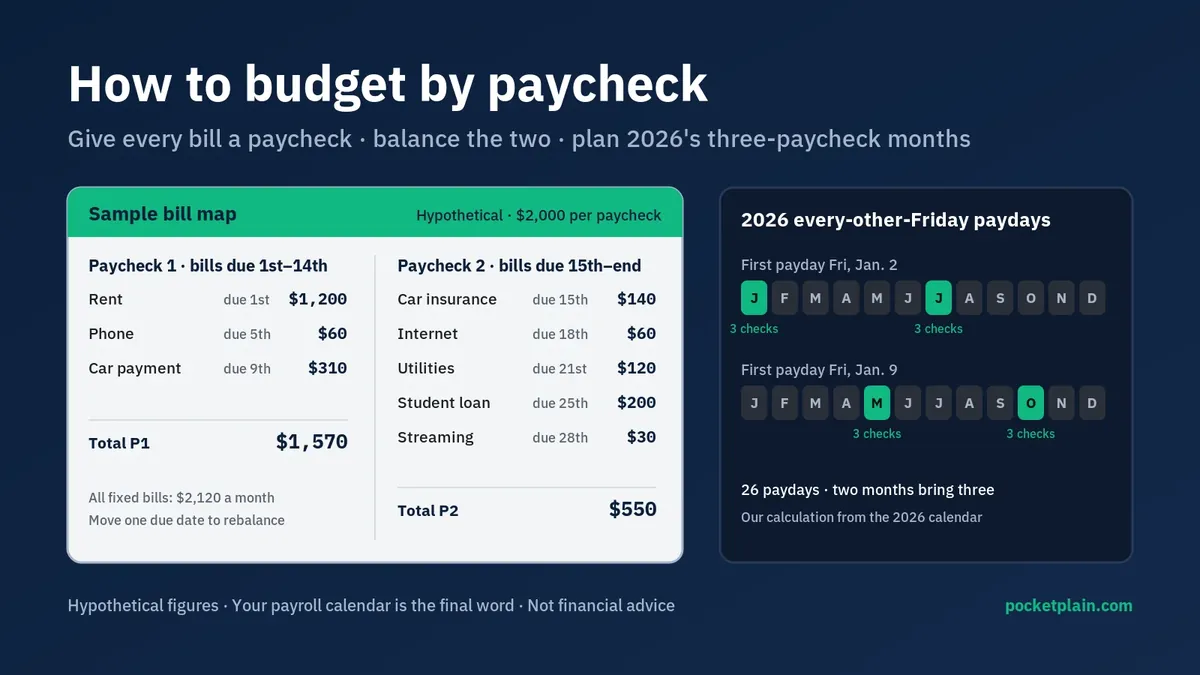
Sample bill map (hypothetical example)
| Bill | Due day | Amount | Paycheck |
|---|---|---|---|
| Rent | 1st | $1,200 | P1 |
| Phone | 5th | $60 | P1 |
| Car payment | 9th | $310 | P1 |
| Car insurance | 15th | $140 | P2 |
| Internet | 18th | $60 | P2 |
| Utilities (estimate) | 21st | $120 | P2 |
| Student loan | 25th | $200 | P2 |
| Streaming | 28th | $30 | P2 |
| Total | $2,120 | P1 $1,570 · P2 $550 |
Hypothetical example, not a real household.
Rent tends to dominate the map. In federal data, housing was 33.4% of average annual spending by U.S. consumer units in 2024, the largest category. BLS, Consumer Expenditures 2024 In this hypothetical example, the $1,200 rent is 60% of one $2,000 paycheck. Seen per paycheck, the pressure on P1 is obvious.
Balance the two paychecks
Fixed bills aren't the only costs. Groceries, gas, and household items come out of every paycheck. In our example, that's $380 per check ($250 groceries, $80 gas, $50 household).
Left over per paycheck (hypothetical example)
| P1 | P2 | |
|---|---|---|
| Take-home pay | $2,000 | $2,000 |
| Fixed bills (before) | $1,570 | $550 |
| Every-paycheck spending | $380 | $380 |
| Left over (before) | $50 | $1,070 |
| Fixed bills (after moving the car payment to the 20th) | $1,260 | $860 |
| Left over (after) | $360 | $760 |
Hypothetical example; our own calculation.
Same income, same bills, same total. Moving one due date turns a paycheck with $50 of slack into one with $360. If the bills were split perfectly evenly, each paycheck would carry $1,060. Rent alone is $1,200, so a perfect split isn't possible here, and it doesn't need to be.
The CFPB's "Improving cash flow" worksheet lists ways to make that shift: CFPB Improving cash flow
- Ask for a new due date so a bill is due after you receive income. The CFPB suggests starting with companies where you have a good payment history.
- Split a large monthly payment into two smaller ones due at different times. Its example: covering $700 rent with a $350 payment on the 1st and the 15th.
- Try a level payment plan for utilities, which averages a year's use so you pay the same each month.
- Automatically set aside a monthly amount in savings so large, periodic payments, like car insurance, are already covered when they're due.
On a biweekly budget, a per-paycheck set-aside works the same way. Hypothetical example: $1,040 a year of irregular costs is $40 per paycheck over 26 checks.
The three-paycheck months of 2026
There are 52 Fridays in 2026, because the year starts on a Thursday, Jan. 1. An every-other-Friday schedule therefore has 26 paydays this year, and two months get three. Which two depends on when your first 2026 payday fell.
| If your first 2026 payday was… | Three-paycheck months in 2026 |
|---|---|
| Friday, Jan. 2 | January (2, 16, 30) and July (3, 17, 31) |
| Friday, Jan. 9 | May (1, 15, 29) and October (2, 16, 30) |
Our calculation from the 2026 calendar. Your employer's payroll calendar is the final word.
Is that third check extra money? Not automatically. It's part of your annual pay that happens to land in the same month. With the P1/P2 rule, though, some paychecks carry no fixed monthly bills at all. With a 3-day buffer, those are May 15 and Nov. 13 on the Jan. 9 schedule, and March 13 and Aug. 14 on the Jan. 2 schedule (our calculation; with a 2-day buffer the dates shift slightly). Decide in advance what it's for, whether that's the emergency fund, annual costs, or debt, so it doesn't disappear into the month.
Which bills each fall paycheck covers (Jan. 9 schedule, our calculation)
| Payday | Role | Covers bills for |
|---|---|---|
| Fri, Sep. 18 | P1 | October (1st–14th) |
| Fri, Oct. 2 | P2 | October (15th–end) |
| Fri, Oct. 16 | P1 | November (1st–14th) |
| Fri, Oct. 30 | P2 | November (15th–end) |
| Fri, Nov. 13 | No fixed monthly bills | Your choice in advance |
| Fri, Nov. 27 | P1 | December (1st–14th) |
| Fri, Dec. 11 | P2 | December (15th–end) |
| Fri, Dec. 25 | P1 | January 2027 (1st–14th) |
Holidays can move a payday. Christmas Day, Friday, Dec. 25, 2026, is a federal holiday, and so are Juneteenth (Friday, June 19), Independence Day observed (Friday, July 3), and New Year's Day 2027 (Friday, Jan. 1). OPM federal holidays Those dates fall on paydays in one of the two schedules above. When a payday lands on a holiday, the actual pay date depends on your employer, so check your payroll calendar. How often you must be paid is also set partly by state law, and the rules vary by state. DOL state payday requirements
Build your own paycheck budget in 4 steps
- List your bills with due days and amounts. Include anything that's paid automatically. Your statements and bank history are the best source.
- Label each bill P1 or P2. Due the 1st through the 14th goes to P1; due the 15th or later goes to P2. If your bills cluster on other days, use the same logic around your largest bill's due date instead of the 1st.
- Subtract every-paycheck spending from each check. If one paycheck is left with little or nothing, look at the CFPB moves above: a new due date, a split payment, or a level plan.
- Mark your paydays for the year and name the checks with no fixed bills. Decide what they're for before they arrive.
To track the weeks in between, the CFPB's cash flow budget worksheet has you add income and subtract expenses week by week, so you can see a short week before it happens. It's part of the CFPB's Your Money, Your Goals toolkit, which also includes the bill calendar.
Download the example bill map: Excel (.xlsx) or CSV. It contains the sample bills above, a P1/P2 formula, and every-other-Friday paydays for 2026 on both schedules. Replace the sample numbers with yours. No email or sign-up needed.
To check the plan against your monthly numbers, try the budget check. If you're building a cushion with the checks that carry no fixed bills, the emergency fund calculator and our guide to emergency fund planning can help you set a target. If debt payments are part of your map, see debt snowball versus avalanche for two ways to decide where extra dollars go.
FAQ
Is the third paycheck extra money? Not automatically. It's part of your annual pay that lands in the same month as two others. Over a year, the third-paycheck months make up for the two-paycheck months that fall short of the monthly average.
What if I'm paid semimonthly? Then you get 24 paychecks a year, always two per month, so there are no three-paycheck months. You can still assign each bill to the first or second check of the month.
What if my bills are due on other days? The same rule applies. Give each bill to the last paycheck that arrives at least a few days before its due date. If most of your big bills cluster around one date, use that date the way this guide uses the 1st.
Sources and how this guide was made
- Government (IRS): Publication 15-T (2026), Table 3, for pay periods per year; the Tax Withholding Estimator.
- Government (BLS): Length of pay periods in the CES survey (private establishments, February 2023); Consumer Expenditures 2024 news release for the housing share.
- Federal Reserve: Economic Well-Being of U.S. Households in 2025, income and expenses section.
- Government (CFPB): Your Money, Your Goals worksheets: Bill calendar, Improving cash flow, and Creating a cash flow budget.
- Government (OPM and DOL): 2026 and 2027 federal holiday schedules; state payday requirements table.
- Hypothetical example and our calculation: the $2,000 paycheck, the sample bill map, the left-over amounts, and the irregular-cost example are a hypothetical example. The 2026 payday calendars, three-paycheck months, and the P1/P2 check are our own calculation from the calendar. The P1/P2 rule is our method, not a CFPB or government recommendation.
All sources were checked on Oct. 19, 2026.
This article is educational information, not financial advice. Your pay schedule, take-home pay, and bill due dates are what apply to you; check your payroll calendar and statements, and consider speaking with a qualified professional about your situation.