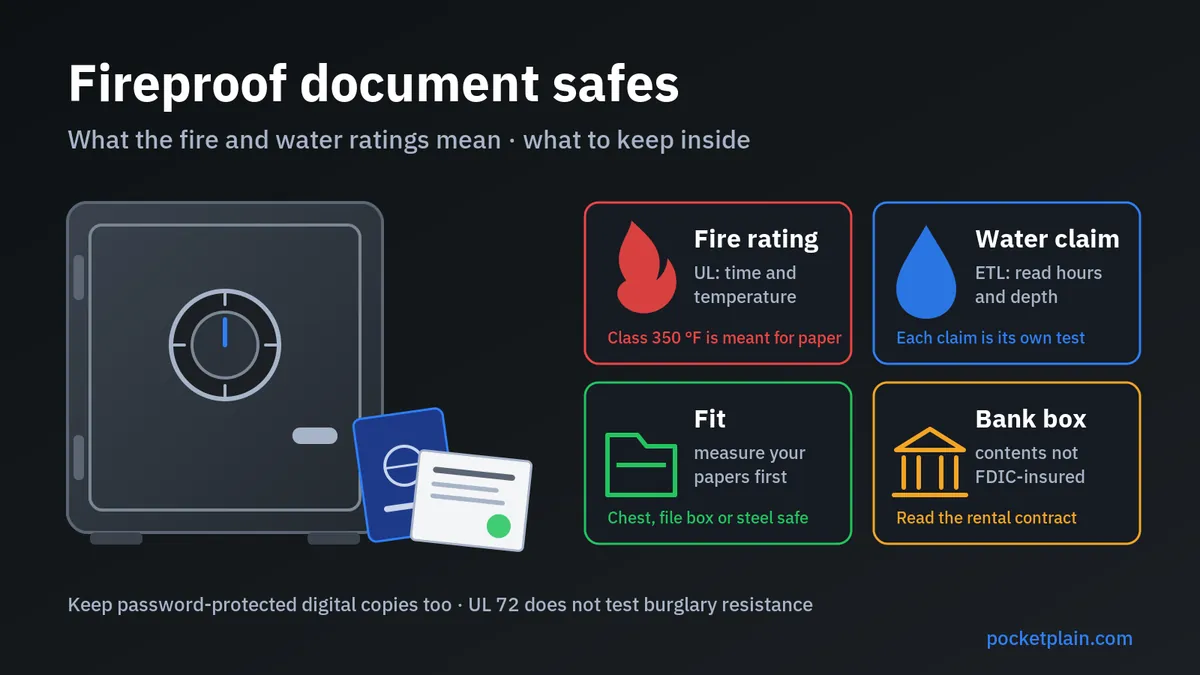
A fireproof document safe is a box that keeps paper records below a damaging temperature for a rated length of time, so the papers you'll need after a fire, such as passports, birth certificates, insurance policies, and deeds, are still readable. Its fire rating doesn't cover theft, it doesn't replace insurance, and it isn't the only copy you should have. When you compare models, look at four things: the UL fire rating (how long and how hot), how the water claim is worded, whether the interior fits your documents, and how the lock and mounting fit your home. This guide explains each one using the UL 72 standard, FEMA, the FDIC, and the IRS, then compares five models on their makers' published specifications.
SentrySafe CHW20221SentrySafe HD4100SentrySafe FHW40300SentrySafe SFW123DSBMaster Lock STW123GTCML
Prices and availability on Amazon change often; check the current listing before you buy. The buttons follow the order of the comparison table in this article.
What to keep in a document safe
FEMA's checklist for safeguarding critical documents starts with the papers that prove who you are: vital records (birth, marriage, and divorce certificates, adoption and child custody papers), passports, driver's licenses, Social Security cards, green cards, and military IDs. It then lists financial and legal papers, including leases, mortgages, and deeds; vehicle titles and registrations; insurance policies with photos and lists of valuable items; tax returns; and estate documents such as a will, trust, or power of attorney. It also includes medical information like insurance cards, medication lists, and a living will. FEMA: Safeguard Critical Documents and Valuables
Ready.gov explains why these matter: after a disaster, access to financial, insurance, medical, and other records is crucial for starting recovery quickly, and a Social Security card, for example, is listed as a document used to apply for FEMA disaster assistance. Ready.gov: Financial Preparedness
For tax papers, the IRS's general rule is to keep records that support income, deductions, or credits on a return until the period of limitations for that return runs out, and to keep copies of the filed returns themselves. IRS: How long should I keep records? The IRS gives these income tax periods:
- 3 years, unless one of the 6-year or indefinite situations below applies.
- 3 years from filing or 2 years from paying the tax, whichever is later, if you file a claim for a credit or refund.
- 7 years if you claim a loss from worthless securities or a bad debt deduction.
- 6 years if you leave out income that is more than 25% of the gross income on your return.
- Indefinitely if you don't file a return or file a fraudulent one.
- Property records until the period of limitations expires for the year you sell or otherwise dispose of the property.
The IRS adds that your insurer or creditors may require you to keep some records longer, so check before discarding anything.
Keep digital copies outside the box too
A safe protects one copy in one place. FEMA suggests also storing electronic copies of important documents in a password-protected format, either on a removable flash drive or external hard drive kept in your fireproof and waterproof box or safe, or with a secure cloud-based service. Ready.gov likewise suggests storing important documents in a safe deposit box, on an external drive, or in the cloud so they are easy to reach during a disaster.
Photos and videos of your home are worth including. After a disaster, the IRS suggests looking for pictures that show damaged property before the event and supporting values with photographs, videos, canceled checks, or receipts. IRS: Reconstructing records If tax records are lost, the IRS says you can get free return transcripts through its Get Transcript tool, or request transcripts or copies of past returns by mail with Form 4506-T or Form 4506. Our article on the IRS app that replaced IRS2Go covers another official way to see available records.
Digital copies of tax and identity papers are sensitive. Our article on the IRS's security reminder for tax data covers its advice on secure storage, encryption, and backups.
How UL fire ratings work
The fire claims on the models compared below cite UL testing. The UL standard for this kind of product is UL 72, Tests for Fire Resistance of Record Protection Equipment; its current edition, the 17th, is dated January 27, 2026. UL 72 Its scope explains what a rating does and doesn't tell you:
- What is tested. Equipment goes through a fire endurance test and an explosion test; models meant to resist impact also go through a fire and impact test. The endurance test checks that temperatures inside the device don't exceed the limits for the class being sought.
- What the class means. In the U.S., Class 350 °F devices are intended to protect paper records. Class 150 °F devices are intended for paper and non-paper records such as magnetic tapes and photographic records, and Class 125 °F devices are intended to also protect flexible computer disks. Non-paper records are not used as contents in the tests.
- What is not covered. The burglary resistance of locks is outside the standard's scope, and the tests aren't meant to determine whether equipment can be used again after a fire. UL 72 also notes that its test fires may not represent every real fire.
The product pages we checked express the rating as a time and an outside temperature, such as "1/2 hour up to 1550°F." Master Lock, in a fire-rating guide that SentrySafe's buying guide links to, describes the test this way: heat is applied to the outside of a safe with paper inside, and for the highest UL rating the internal temperature can't exceed 350°F for the duration of the test. Master Lock A longer duration at a higher temperature means the box held up in a harsher test. The product pages we checked list the duration and temperature but not the UL class number, so if the class matters to you, check the label or ask the manufacturer.
If you plan to store USB drives or other digital media, look for a specific digital media claim on the product page and keep a second copy elsewhere, since UL 72's paper-oriented Class 350 °F is not aimed at those media. All five product pages list "Digital Media Protection" as a feature, but none states a UL class for it.
What waterproof claims mean
Water can damage papers in a fire as well as a flood. Master Lock notes that a house fire can bring significant water from sprinklers or fire hoses.
Water ratings work differently from fire ratings. Master Lock describes ETL Verified as a mark issued by Intertek that confirms a manufacturer meets its own internal test requirements, used for claims like water testing where there isn't an existing standardized test. In practice, compare the exact wording. Some listings below give hours only ("flood damage up to 72 hours"), while others give hours and a depth ("up to 8 inches of water for up to 24 hours"). Because each claim reflects its own test, the hour count alone doesn't tell you which box would stay drier in your situation.
Placement matters too. FEMA suggests moving valuables stored in a basement to a higher location and putting them in waterproof containers.
Home safe vs. bank safe deposit box
FEMA lists both as options for paper copies, along with leaving copies with a trusted friend or relative. The trade-offs:
| Fire-rated box at home | Bank safe deposit box | |
|---|---|---|
| Access | Whenever you are home, including nights and weekends | During the bank's hours; FEMA suggests checking who can open it if the renter dies or is incapacitated |
| Fire protection | UL Classified for a set time and outside temperature, per the manufacturer; UL 72 is UL's fire test standard for this kind of equipment | Depends on the bank's vault; read the rental contract |
| Theft protection | Not part of UL 72; varies by model and mounting | Kept at the bank; read the rental contract for what the bank covers |
| Insurance | Depends on your homeowners or renters policy FDIC | Contents are not insured by the FDIC |
The FDIC is explicit: the contents of a safe deposit box are not insured by the FDIC. It says to read the contract you signed with the bank to see whether other insurance is provided, and notes that some banks may make a very limited payment if the box or contents are damaged or destroyed, depending on the circumstances. For concerns about safety or replacement, the FDIC suggests considering fire and theft insurance, usually part of a homeowners or tenant's policy. If the bank fails, the FDIC says another institution usually takes over its offices, including safe deposit boxes; if not, the FDIC will contact you with instructions for removing the contents. That is a different protection from the deposit insurance on your accounts, which our guide to how FDIC deposit insurance works explains.
One way to split the job: originals that are hard to replace go in the bank box, and copies plus papers you may need quickly go in a fire-rated box at home. A box at home is also a place for a small amount of cash. Ready.gov suggests keeping some at home in a safe place, in small bills, because ATMs and credit cards may not work during a disaster. For the larger cushion, see our guide to building an emergency fund.
Five fire and water safes compared
The five models below are sized for household documents and carry both a fire and a water claim on the manufacturer's website. Specifications are from each model's page on sentrysafe.com, checked October 17, 2026. Pocket Plain did not test these products, and the order runs from smallest to largest interior, not from best to worst. Prices change often, so none are listed here.
| Model | Type | Fire claim (per manufacturer) | Water claim (per manufacturer) | Interior capacity | Lock | Weight | Where to buy |
|---|---|---|---|---|---|---|---|
| SentrySafe CHW20221 | Chest with carry handle | UL Classified, 1/2 hour up to 1550°F (843°C) | ETL Verified, flood damage up to 72 hours | 0.28 cu. ft. | Key | 20.4 lb | Check current price on Amazon |
| SentrySafe HD4100 | File box | UL Classified, 1/2 hour up to 1550°F (843°C) | ETL Verified, flood damage up to 72 hours | 0.65 cu. ft. | Key | 38.85 lb | Check current price on Amazon |
| SentrySafe FHW40300 | File box | UL Classified, 1/2 hour up to 1550°F (843°C) | ETL Verified, flood damage up to 72 hours | 0.66 cu. ft. | Digital | 43 lb | Check current price on Amazon |
| SentrySafe SFW123DSB | Steel safe | UL Classified, 1 hour up to 1700°F (927°C) | ETL Verified, up to 8 inches of water for up to 24 hours | 1.19 cu. ft. | Combination dial plus key | 86.3 lb | Check current price on Amazon |
| Master Lock STW123GTCML | Steel safe | UL Classified, 2 hours up to 1850°F (1010°C) | ETL Verified, up to 8 inches of water for up to 24 hours | 1.19 cu. ft. | Digital plus key | 128.2 lb | Check current price on Amazon |
SentrySafe CHW20221. A low chest for a handful of key documents and small items. SentrySafe lists interior dimensions of 4.4 in. H × 12.8 in. W × 8.5 in. D, an in-lid organizer for items like passports, a carrying handle, and a tubular key. Measure your largest papers against those dimensions before buying.
SentrySafe HD4100. A file box for people who keep papers in folders. SentrySafe says it holds up to 40 standard hanging folders and has in-lid organization for passports, checkbooks, and digital media. It describes the privacy key lock as basic protection that is not intended for tool attacks.
SentrySafe FHW40300. A similar-size file box with a programmable digital lock, so you choose your own combination. SentrySafe lists 0.66 cu. ft. of interior space for hanging folders. SentrySafe's buying guide describes its digital locks as battery-powered, so read the manual for battery and backup-access instructions. SentrySafe buying guide
SentrySafe SFW123DSB. A step up to a steel safe with a longer fire rating. SentrySafe lists four 1-inch bolts, a pry-resistant hinge bar, bolt-down hardware, a dual key, and an adjustable shelf, and says its live-locking bolts, steel construction, and hinge bar give its best protection from forced entry and tool attacks. SentrySafe's page lists 1.19 cu. ft. of interior capacity; some retail listings describe it as 1.23 cu. ft. We use the manufacturer's figure.
Master Lock STW123GTCML. The same interior size with the longest fire rating here, 2 hours up to 1850°F. The page lists a programmable digital code with a dual key, four bolts, a pry-resistant hinge bar, bolt-down hardware, and interior lighting. At 128.2 lb, it is also the heaviest model here.
How to choose the right size and rating
- Gather what you'd store first. Use FEMA's list as a checklist, then measure the stack. Folders point to a file box; a few certificates and passports fit a chest.
- Match the fire rating to what's at stake. All five carry a UL fire claim; the steel safes list longer durations at higher temperatures. Remember that UL 72 tests fire resistance, not resistance to break-ins.
- Read the water claim word for word. Note the hours and whether a depth is given.
- Think about theft separately. A 20-pound chest with a carrying handle is portable by design. If theft is a concern, look at steel construction and bolt-down hardware, which SentrySafe lists on its larger safes.
- Plan access. Decide who else should know where the key or code is, and keep copies of the most important papers somewhere outside your home, as FEMA suggests.
- Review your insurance. A safe protects papers, not their value. Ready.gov notes that homeowners insurance does not typically cover flooding, which may call for flood insurance through the National Flood Insurance Program.
SentrySafe CHW20221SentrySafe HD4100SentrySafe FHW40300SentrySafe SFW123DSBMaster Lock STW123GTCML
Prices and availability on Amazon change often; check the current listing before you buy. The buttons follow the order of the comparison table in this article.
Treat a safe as a planned purchase in your budget rather than something paid for from savings set aside for emergencies. If you're still sizing that savings, see how much emergency fund you need.
How we chose and the limits of this comparison
To be included, a model had to be sized for household documents, list both a fire and a water claim on the manufacturer's own product page, and have an Amazon.com listing that we could open directly and match to the model on October 17, 2026. For the Master Lock STW123GTCML, the listing's title names that model, but its model number field shows STW123GTC, a SentrySafe-branded version that SentrySafe lists with the same fire, water, capacity, size, and weight specifications. SentrySafe STW123GTC We also tried to include a Honeywell model, but its Amazon listing didn't load for us in a way we could confirm, so it's not in this comparison. All five come from SentrySafe's catalog, which also lists the Master Lock model. Other brands make fire-rated document boxes; leaving them out is not a judgment of their quality, and we may add models whose specifications and listings we can confirm the same way.
We did not test these products, and the specifications are the manufacturers' published claims. Customer ratings, prices, and availability are left out because they change often and vary by seller. The Amazon links are affiliate links; the selection and the order of the table don't depend on them.
Sources and how this guide was made
- FDIC: Financial products that are not insured by the FDIC, including the safe deposit box section (last updated May 12, 2026).
- FEMA / Ready.gov: Safeguard Critical Documents and Valuables (FEMA P-1096) and Financial Preparedness (last updated Mar. 13, 2026).
- IRS: How long should I keep records? and Reconstructing records after a natural disaster or casualty loss.
- UL Standards & Engagement: UL 72 scope (Edition 17, Jan. 27, 2026).
- Manufacturers: Master Lock's guide to fire ratings, SentrySafe's buying guide, and the SentrySafe product pages for the CHW20221, HD4100, FHW40300, SFW123DSB, and STW123GTCML.
All sources were checked on Oct. 17, 2026. This guide covers U.S. rules and products; manufacturers can change specifications without notice, so confirm the details on the product page and label before you buy.
This content is for general education and is not financial advice. No safe or storage method guarantees that documents will survive every fire, flood, or theft.