Deductions and credits both lower your federal income tax, but they work at different steps of the return. A deduction is subtracted from your income, so you pay tax on less money. A credit is subtracted from the tax itself, which lowers what you owe or raises your refund. IRS, Credits and deductions
That difference is why a $1,000 credit is usually worth far more than a $1,000 deduction. Here's how each one works, with the IRS's 2026 numbers.
The difference in one example
A deduction saves you roughly your marginal tax rate, the rate on your last dollars of income. For 2026, the IRS's rate table puts single filers in the 22% bracket on taxable income over $50,400, and in the 24% bracket over $105,700 (over $100,800 and $211,400 for married couples filing jointly). IRS, IR-2025-103
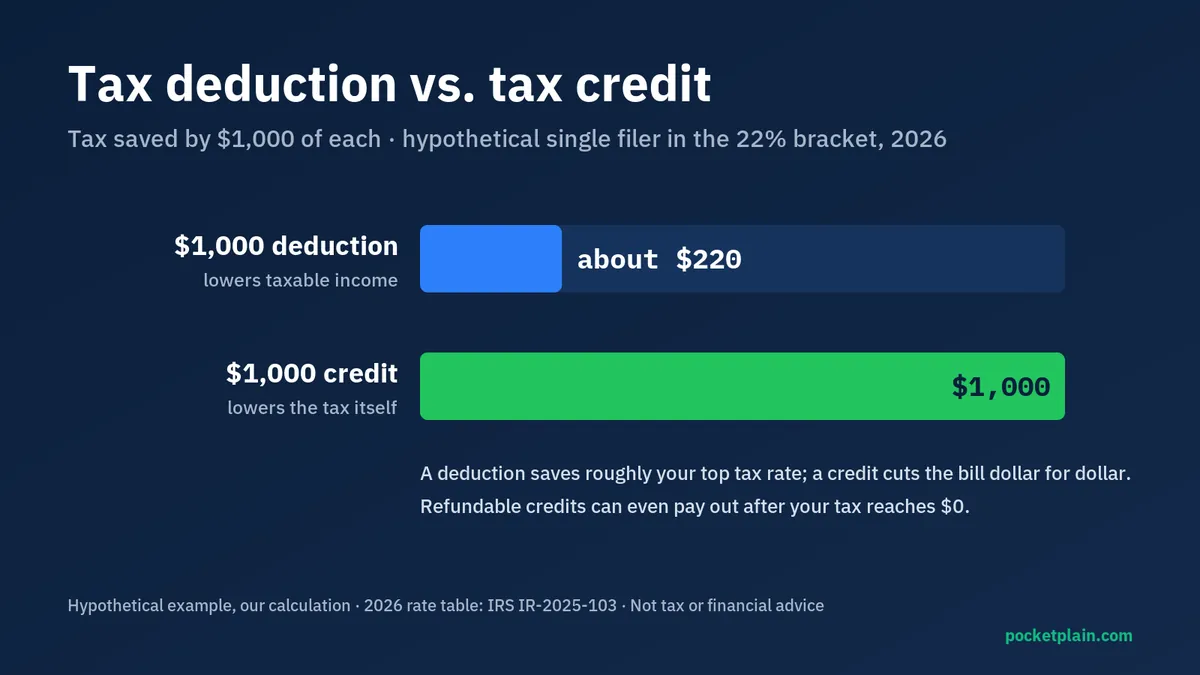
Hypothetical example (our calculation). A single filer with $60,000 of taxable income in 2026 is in the 22% bracket.
| $1,000 deduction | $1,000 credit | |
|---|---|---|
| What it reduces | Taxable income, from $60,000 to $59,000 | The tax bill, by $1,000 |
| Tax saved | About $220 (22% of $1,000) | $1,000 |
The deduction is worth more to people in higher brackets and less to people in lower ones. A credit is worth the same dollar amount to anyone who can use all of it.
How deductions work: standard or itemized
Every filer chooses between the standard deduction, a flat amount based on filing status, and itemizing, which means adding up specific deductible expenses on Schedule A. Most people take the standard deduction. You come out ahead by itemizing only if your allowable itemized deductions are greater than your standard deduction. IRS, Topic no. 501
| Filing status | Standard deduction, 2025 | Standard deduction, 2026 |
|---|---|---|
| Single or married filing separately | $15,750 | $16,100 |
| Married filing jointly | $31,500 | $32,200 |
| Head of household | $23,625 | $24,150 |
People 65 and older and blind taxpayers can get an additional standard deduction. If you're married filing separately and your spouse itemizes, you can't take the standard deduction.
Common itemized deductions, subject to limits, include state and local income or sales taxes, property taxes, mortgage interest, gifts to charity, disaster losses and medical and dental expenses above 7.5% of adjusted gross income.
Hypothetical example (our calculation). A single filer pays $9,000 in mortgage interest, $5,000 in state and local taxes and gives $1,500 to charity in 2026. That's $15,500, less than the $16,100 standard deduction, so the standard deduction gives the lower tax.
Deductions you can take without itemizing
Some deductions reduce your income even if you take the standard deduction. The IRS lists, among others, money you put in a traditional IRA or a health savings account, student loan interest, teacher expenses and penalties on early withdrawals from savings.
The Working Families Tax Cuts law added four deductions for tax years 2025 through 2028 that are also available whether or not you itemize: IRS, individuals and workers
| New deduction (2025-2028) | Maximum | Phase-out starts at modified AGI of |
|---|---|---|
| Seniors 65 and older | $6,000 per eligible person ($6,000 for each spouse who qualifies) | $75,000 ($150,000 joint) |
| Qualified tips | $25,000 | $150,000 ($300,000 joint) |
| Qualified overtime (the premium portion) | $12,500 ($25,000 joint) | $150,000 ($300,000 joint) |
| Interest on a qualifying new car loan | $10,000 | $100,000 ($200,000 joint) |
Each one has its own conditions. For example, the car loan must have originated after Dec. 31, 2024, for a personal-use vehicle with final assembly in the United States, and lease payments don't count. Starting with tax year 2026, people who don't itemize can also deduct up to $1,000 of cash gifts to eligible charities ($2,000 for married couples filing jointly). IRS, Working Families Tax Cuts
If you have an HSA or contribute to an IRA, see our guides to 2026 HSA limits and 2026 401(k) and IRA limits. Our comparison of Roth vs. traditional IRAs weighs a deduction now against tax-free withdrawals later.
How credits work: refundable or not
Most credits can reduce your tax only until it reaches $0. Refundable credits go further and pay you the remaining amount as a refund, even if you owe no tax. That's why the IRS says it's best to file even when you aren't required to: many people who qualify for refundable credits miss out because they don't file. IRS, Refundable tax credits
Hypothetical example (our calculation). Your tax before credits is $800 and you qualify for a $1,000 credit.
- If it's nonrefundable, your tax drops to $0 and the other $200 doesn't come back to you.
- If it's refundable, your tax drops to $0 and you get the $200 as a refund.
Some credits are partly refundable. For tax year 2025, according to the IRS:
| Credit | Maximum | Refundable part |
|---|---|---|
| Earned Income Tax Credit | Depends on income and children | Fully refundable |
| Child Tax Credit | Up to $2,200 per qualifying child | Up to $1,700 per child |
| American Opportunity Tax Credit | Up to $2,500 per year | Up to $1,000 |
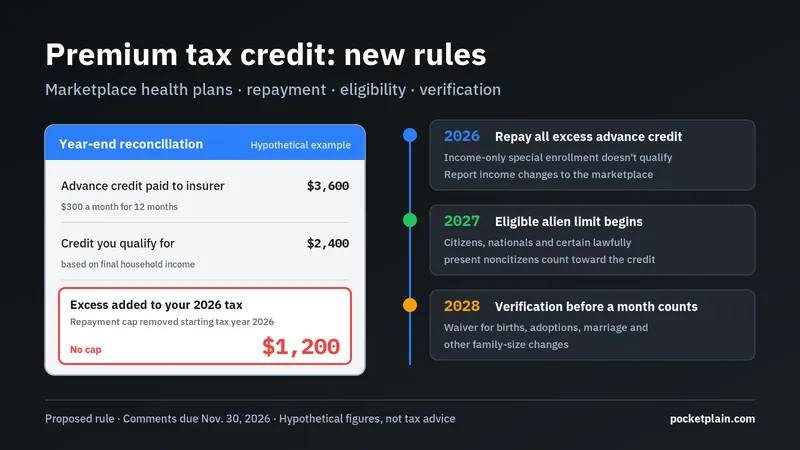
| Premium Tax Credit | Based on income and plan cost | Fully refundable |
| Adoption credit | Up to $17,280 per child | Up to $5,000 |
The Child and Dependent Care Credit is also changing: starting with tax year 2026, the maximum credit rate rises from 35% to 50% of qualifying expenses, still capped at $3,000 of expenses for one person and $6,000 for two or more.
For two credits we've covered in depth, see the premium tax credit proposed rules and adoption credit carryforward refunds.
Which helps you more
There's no single answer, because you don't usually choose between a deduction and a credit: you claim every one you qualify for. A few practical points:
- Check credits first. A credit you qualify for usually moves your bill more than a deduction of the same size.
- Compare itemizing with the standard deduction each year. Tax software does this automatically, but the comparison changes when you buy a home, pay off a mortgage or give more to charity.
- Don't skip the deductions that don't require itemizing. IRA, HSA and student loan interest deductions, and the new 2025-2028 deductions, count even with the standard deduction.
- Keep records. The IRS says you need documents to support the expenses or losses you deduct.
Rules, limits and income phase-outs change, and many depend on details such as filing status and dependents. For your own return, use the IRS instructions or a qualified tax professional.
Sources
- Internal Revenue Service: "Credits and deductions for individuals" and "Topic no. 501, Should I itemize?"
- Internal Revenue Service: IR-2025-103, 2026 inflation adjustments (standard deduction and rate table).
- Internal Revenue Service: "Refundable tax credits."
- Internal Revenue Service: Working Families Tax Cuts provision pages (individuals and workers; families and charitable giving).
All sources were checked on Oct. 21, 2026.
This content is for general education and is not financial advice or tax advice.