Video version: coming Saturday, Oct. 24, on Steady Wallet.
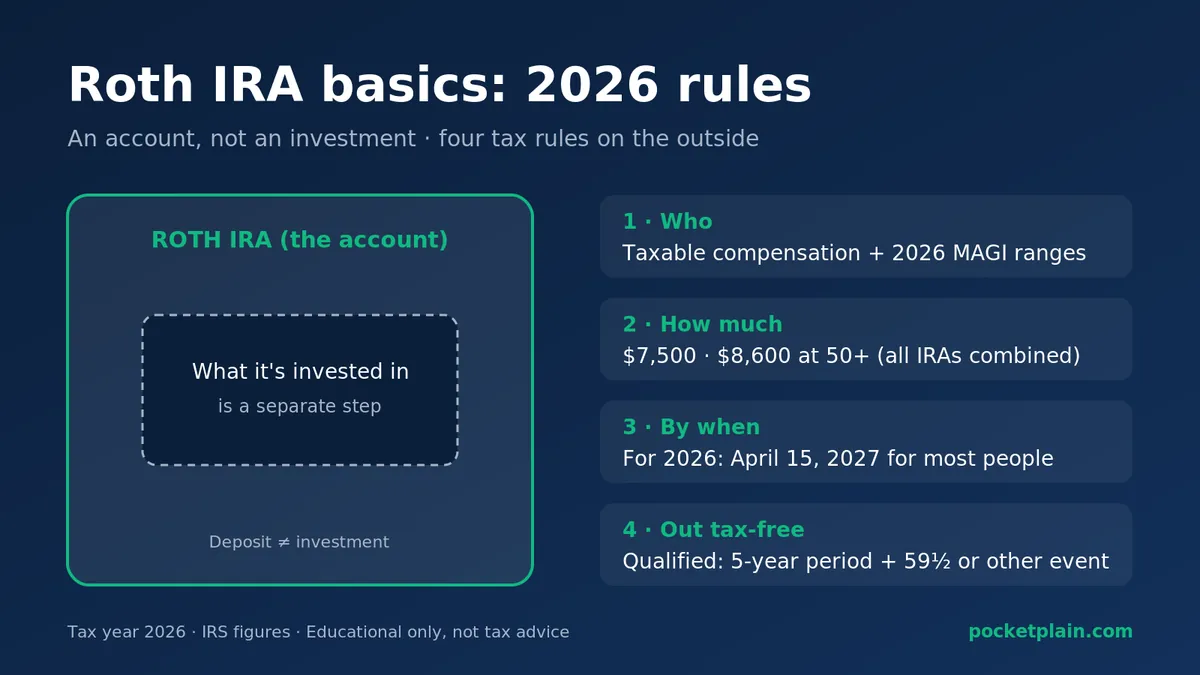
A Roth IRA is an account, not an investment: a container with four tax rules on the outside — who can put money in, how much, by when, and when it can come out tax-free. What goes inside is a separate decision. This guide answers seven beginner questions about those rules for tax year 2026, with an IRS source for each number.
Pocket Plain is owned and edited by Thiago Costa, who also runs the Steady Wallet YouTube channel. This guide is the written companion to Steady Wallet's video on Roth IRA basics. Pocket Plain may earn money from ads on this page; this article contains no affiliate links. Educational only — not financial, investment, or tax advice.
A Roth IRA is an account, not an investment
Retirement accounts are common, but confidence is not. In the Federal Reserve's survey of U.S. households in 2025, 61% of adults had a tax-preferred retirement account such as a 401(k), an IRA or a Roth IRA, yet only 35% of non-retirees thought their retirement saving was on track. Federal Reserve, Economic Well-Being of U.S. Households in 2025
7 questions, 7 short answers (tax year 2026)
| Question | Short answer |
|---|---|
| 1. What is a Roth IRA? | An IRA designated as a Roth when it is set up. Contributions aren't deductible; qualified distributions are tax-free. |
| 2. How much can you contribute? | $7,500, or $8,600 if you're 50 or older, combined across all your IRAs, or your taxable compensation if less. |
| 3. Do you need earned income? | Yes. You need taxable compensation, such as wages or self-employment income, or a spouse with compensation on a joint return. |
| 4. Does your income let you contribute? | It depends on your modified AGI and filing status. The amount phases out from $153,000 to $168,000 for single filers. |
| 5. What's the deadline? | Contributions for 2026 can be made until the tax filing deadline (April 15, 2027 for most people). |
| 6. When can money come out tax-free? | Regular contributions come out first and aren't taxed. Earnings need the five-year period plus age 59½ or another qualifying event. |
| 7. Is the money invested? | Not automatically. Money you deposit can sit as uninvested cash until you choose investments. |
1. What is a Roth IRA?
A Roth IRA is an individual retirement arrangement with its own tax treatment. The IRS sums up the core rules: you cannot deduct contributions to a Roth IRA, and if you satisfy the requirements, qualified distributions are tax-free. The account or annuity must be designated as a Roth IRA when it is set up. You can keep contributing after age 70½, and you can leave amounts in your Roth IRA as long as you live. IRS, Roth IRAs
The "account, not investment" idea comes straight from how the IRS describes opening one. Publication 590-B says a Roth IRA is generally subject to the rules that apply to a traditional IRA, and Publication 590-A says you can open an IRA at a bank or other financial institution, with a mutual fund or life insurance company, or through a stockbroker. Contributions, except for rollover contributions, must be in cash. You put money into the account; buying an investment inside it is a separate step (Question 7).
Account ≠ investment. The Roth label describes how the account is taxed. It says nothing about what the money is held in.
The main difference from a traditional IRA is when the tax benefit arrives; our comparison of Roth vs. traditional IRAs covers that choice.
2. How much can you contribute for 2026?
For 2026, the IRS raised the annual IRA contribution limit to $7,500, up from $7,000. The catch-up contribution for people age 50 and over rose to $1,100, up from $1,000, for a total of $8,600. IRS news release IR-2025-111, Nov. 13, 2025 The catch-up applies if you reach age 50 before the end of the year, according to the IRS notice that sets the 2026 limits. IRS Notice 2025-67
2026 IRA limits
| Your age at the end of 2026 | 2026 limit |
|---|---|
| Under 50 | $7,500 |
| 50 or older | $8,600 ($7,500 + $1,100 catch-up) |
Two rules shape that number. First, it is one limit combined across all your traditional and Roth IRAs, not a separate limit for each account. Second, the limit is $7,500 ($8,600 if you're 50 or older) or your taxable compensation for the year, if less. IRS, IRA contribution limits
Going over the limit has a cost. Excess contributions are taxed at 6% per year for each year the excess stays in the IRA. To avoid the 6% tax, the IRS says you must withdraw the excess contributions and any income earned on them by the due date of your return, including extensions.
Workplace plans such as 401(k)s have their own 2026 limits; our guide to 2026 401(k) and IRA limits covers them.
The 2026 limit per paycheck (our calculation, not a target)
| Limit | Monthly (12) | Twice a month (24) | Every two weeks (26) | Weekly (52) |
|---|---|---|---|---|
| $7,500 | $625.00 | $312.50 | $288.46 | $144.23 |
| $8,600 | $716.67 | $358.33 | $330.77 | $165.38 |
Simple division, rounded to the cent (26 or 52 rounded payments add up to $7,499.96). It is not a recommendation about how much to contribute.
3. Do you need earned income?
Yes. You can only contribute up to your taxable compensation for the year. In IRS terms, compensation is generally what you earn from working. Publication 590-A's Table 1-1 lists what does and doesn't count. IRS Publication 590-A (2025)
| Counts as compensation | Doesn't count |
|---|---|
| Wages, salaries, tips, bonuses and commissions | Interest and dividend income |
| Self-employment income | Earnings and profits from property, such as rental income |
| Taxable alimony and separate maintenance (under the publication's rules) | Pension or annuity income |
| Nontaxable combat pay |
Hypothetical example. Suppose someone earns $4,000 in taxable compensation in 2026 from a part-time job. Because the limit is $7,500 or taxable compensation if less, that person's 2026 IRA limit is $4,000.
Spousal IRA. If you file a joint return, you may be able to contribute even if you didn't have taxable compensation, as long as your spouse did. Each spouse can contribute up to the limit, but the combined total can't be more than the taxable compensation reported on the joint return.
4. Does your income let you contribute?
Even with enough compensation, a Roth IRA has an income test. The IRS measures it with your modified adjusted gross income (MAGI) for Roth IRA purposes, which is not the same as your salary: it starts from your AGI with specific adjustments, which Publication 590-A walks through in Worksheet 2-1.
2026 MAGI ranges for Roth IRA contributions
| Filing status | Full contribution | Reduced contribution | No direct contribution |
|---|---|---|---|
| Single, head of household, or married filing separately and you didn't live with your spouse at any time in 2026 | Below $153,000 | $153,000 to under $168,000 | $168,000 or more |
| Married filing jointly or qualifying surviving spouse | Below $242,000 | $242,000 to under $252,000 | $252,000 or more |
| Married filing separately and you lived with your spouse at any time in 2026 | None | More than $0 to under $10,000 | $10,000 or more |
The 2026 ranges come from IR-2025-111. The married-filing-separately range is not subject to an annual cost-of-living adjustment and stays at $0 to $10,000.
In the reduced zone, Publication 590-A's Worksheet 2-2 figures the reduced amount. The 2025 edition still shows 2025 dollar amounts in its table and worksheet; the 2026 ranges above are the ones for 2026 contributions. If you're in that zone, consider asking a tax professional.
Converting money from a traditional IRA follows separate rules and isn't covered here.
5. What's the deadline for 2026 contributions?
Publication 590-A says you can make contributions to a Roth IRA for a year at any time during the year or by the due date of your return for that year, not including extensions. For 2025 contributions, it says that meant April 15, 2026, for most people.
Applying the same rule one year later, contributions for 2026 can be made until the tax filing deadline (April 15, 2027 for most people). The IRS's general rule puts the filing due date on the 15th, moved to the next business day if the 15th falls on a Saturday, Sunday or legal holiday; April 15, 2027, is a Thursday. IRS, When to file The IRS hasn't yet published the 2027 date itself; this is our reading of its current rules, so confirm it on IRS.gov closer to the deadline. Extensions to file your return don't extend the contribution deadline. The IRS can also postpone tax deadlines for people affected by a presidentially declared disaster, so check IRS.gov if that applies to you.
Label it 2026. If you contribute between January 1 and April 15, make sure the provider records it as a 2026 contribution. Publication 590-A gives this rule for traditional IRAs, whose rules generally apply to Roth IRAs too: if you don't tell the sponsor which year it's for, the sponsor can assume, and report to the IRS, that it's for the current year.
Hypothetical example: the window that's left (our calculation). From Saturday, Oct. 24, 2026, to Thursday, April 15, 2027, there are 173 days and 24 Fridays (Oct. 30 through April 9). Spreading $7,500 over those 24 Fridays would be $312.50 a week. On an every-two-weeks Friday schedule, there are 12 paydays in that window, or $625 per payday. These illustrate the calendar; they aren't targets. The deadline falls in 2027, but the limit is the 2026 limit.
2027 limits: not announced as of Oct. 21, 2026. The 2026 limits were announced on Nov. 13, 2025. As of Oct. 21, 2026, the IRS had not announced 2027 IRA limits: its October 2026 news releases ran through IR-2026-124 (Oct. 16) without one, and its table of cost-of-living adjustments still ended at 2026. IRS news releases for the current month
6. When can money come out tax-free?
Not everything that comes out is the same kind of money, and only qualified distributions are fully tax-free. IRS Publication 590-B (2025)
Withdrawal order. Under the IRS ordering rules, money is treated as coming out of your Roth IRAs in this order:
- Regular contributions.
- Conversion and rollover contributions, on a first-in, first-out basis (for each one, the taxable part first, then the nontaxable part).
- Earnings on contributions.
You don't include in gross income distributions that are a return of your regular contributions. Earnings are different.
What makes a distribution qualified. A distribution is qualified, and isn't taxed, if both of these are true:
- It is made after the five-year period beginning with the first tax year for which a contribution was made to a Roth IRA set up for your benefit.
- It is made on or after the date you reach age 59½, because you are disabled, to a beneficiary or your estate after your death, or for a first home (up to a $10,000 lifetime limit).
If a distribution isn't qualified, the part allocable to earnings may be taxed and may be subject to the 10% additional tax on early distributions, unless an exception applies. Publication 590-B lists the exceptions.
The five-year clock can start before the deposit. The period starts on January 1 of the first year a contribution is made for, not the day the money arrives. In the IRS example, a regular contribution for 2024 made on Feb. 25, 2025, starts the five-year period on Jan. 1, 2024.
Five-year clock, applied to a first contribution for 2026 (our calculation). Whether it's made in 2026 or by April 15, 2027, a first contribution for 2026 starts the clock on Jan. 1, 2026. The five tax years are 2026, 2027, 2028, 2029 and 2030, so the five-year requirement is met from Jan. 1, 2031. A distribution is qualified only if one of the conditions above is also met.
Conversions and rollovers have a separate five-year period for each one, used for the 10% additional tax, and it isn't necessarily the same as the period for qualified distributions. And if you withdraw a contribution, plus any earnings on it, by the due date of your return for that year, the contribution is treated as if you never made it; the earnings are included in income.
Not tax advice. The details depend on your situation; see Publication 590-B or a tax professional.
7. You funded it — is it invested?
Not necessarily. Funding a Roth IRA and investing the money are two different steps. The SEC's investor education office notes that uninvested cash in an investment account may include money you deposit, and that many investment firms have a default cash sweep program that the firm may automatically enroll you in if you do not select another option. What you earn on uninvested cash can vary significantly. SEC Investor Bulletin: Cash Sweep Programs, May 14, 2025 The bulletin covers investment accounts in general, not Roth IRAs specifically, so check what your deposit is actually held in.
Deposit ≠ investment. Check what your contribution is held in after it arrives.
Choosing investments is a separate decision. In the Fed's 2025 survey, 47% of adults said they were mostly or very comfortable choosing and managing their investments, while 53% were not comfortable or only slightly comfortable. We're not naming funds or companies here. For how fund structures work, without picks, see our explainer on index funds vs. ETFs.
The whole flowchart
Can I contribute to a Roth IRA for 2026?
- Did you (or your spouse, on a joint return) have taxable compensation in 2026? No: you can't contribute. Yes: your limit is $7,500 ($8,600 at 50+) or your compensation, if less.
- What's your filing status? It decides which 2026 MAGI range applies.
- Where is your MAGI in that range? Below it: full contribution. Inside it: reduced contribution (Worksheet 2-2). At or above the top: no direct contribution.
- Is it in by April 15, 2027, and labeled for 2026? Contributions for 2026 are due by the tax filing deadline (April 15, 2027 for most people), not including extensions.
FAQ
Can I withdraw my contributions? Under the IRS ordering rules, regular contributions come out first, and a return of regular contributions isn't included in income (Publication 590-B). Details depend on your situation.
Is there an age limit? For 2020 and later, there is no age limit on making regular contributions to traditional or Roth IRAs, according to the IRS.
Do I have to take money out of my own Roth IRA? The IRS says you can leave amounts in your Roth IRA as long as you live.
Sources and how this guide was made
- Government (IRS): News release IR-2025-111 and Notice 2025-67 (2026 limits and income ranges); Roth IRAs; Retirement topics: IRA contribution limits; Publication 590-A (2025) and Publication 590-B (2025); When to file; news releases for the current month and the cost-of-living adjustments table (2027 status).
- Federal Reserve: Economic Well-Being of U.S. Households in 2025, savings and investments section.
- Government (SEC): Investor Bulletin on cash sweep programs for uninvested cash (May 14, 2025).
- Our calculation: the per-paycheck breakdown, the 173-day window with 24 Fridays and 12 biweekly paydays, the April 15, 2027 weekday, and the five-year clock for a first contribution for 2026.
- Hypothetical example: the $4,000 compensation example and the contribution-window illustrations.
Publications 590-A and 590-B are cited in their dated 2025 editions. All sources were checked on Oct. 21, 2026.
This article is educational information, not financial, investment, or tax advice. Your compensation, filing status and MAGI determine what applies to you; check the IRS publications and consider speaking with a qualified tax professional about your situation.