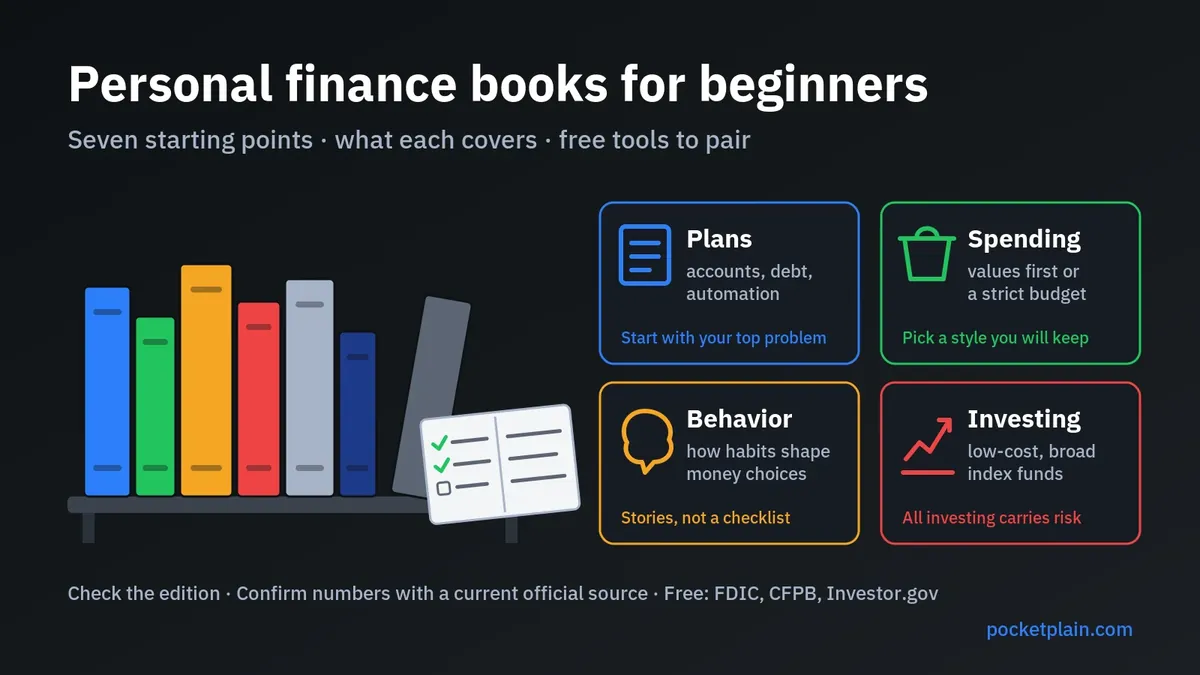
A good first personal finance book gives you a plan you can start this month and the vocabulary to keep learning on your own. The seven books below are written for general readers rather than finance professionals, and each takes a different angle: a six-week setup plan, a debt payoff plan, a guide for people in their 20s and 30s, a values-first program, a book on money behavior, a one-card set of rules, and the case for low-cost index funds. This guide compares what each publisher says the book covers, which edition is current, and how long it is, then points to free federal resources that fill in the gaps. It is not a ranking, and no book replaces advice for your own situation.
I Will Teach You to Be RichThe Total Money MakeoverBroke MillennialYour Money or Your LifeThe Psychology of MoneyThe Index CardThe Little Book of Common Sense Investing
Prices and availability on Amazon change often; check the current listing before you buy. The buttons follow the order of the comparison table in this article.
How we chose these books
To be included, a book had to meet four tests:
- Written for beginners or general readers. Each publisher pitches the book to people managing their own money, not to industry professionals.
- A U.S. focus or broadly applicable advice. The accounts, debts, and investments discussed should make sense for a reader in the United States.
- A current edition we could confirm. We matched each book's ISBN, publisher, and publication date on the publisher's page and in the Open Library catalog, checked October 18, 2026.
- An Amazon.com listing for that exact edition that we could open directly and match to the ISBN on the same day.
We also wanted a mix of topics, so a reader can pick by need: getting organized, paying off debt, spending, behavior, and investing. Other well-known titles were left out to keep the list short, which is not a judgment of their quality.
Seven beginner books compared
The order groups the books by approach, not from best to worst. Page counts and dates are from each publisher's listing, cross-checked with the Open Library catalog and the Amazon listing. Prices change often and vary by format and seller, so none are listed here.
| Book | Author | Edition (publisher, date) | Pages | Best fit if you want | Where to buy |
|---|---|---|---|---|---|
| I Will Teach You to Be Rich, 2nd ed. | Ramit Sethi | Workman Publishing, May 14, 2019, paperback | 352 | A six-week plan for accounts, debt, automation, and saving | Check current price on Amazon |
| The Total Money Makeover, Updated and Expanded | Dave Ramsey | Thomas Nelson, May 14, 2024, hardcover | 272 | A step-by-step plan to pay off debt with the debt snowball | Check current price on Amazon |
| Broke Millennial | Erin Lowry | Tarcher (Penguin Random House), May 2, 2017, paperback | 288 | Money basics for people in their 20s and 30s | Check current price on Amazon |
| Your Money or Your Life, revised for 2018 | Vicki Robin and Joe Dominguez | Penguin Books, paperback | 368 | A nine-step program linking spending to your values | Check current price on Amazon |
| The Psychology of Money | Morgan Housel | Harriman House, Sept. 8, 2020, paperback | 256 | Short stories on how behavior shapes money decisions | Check current price on Amazon |
| The Index Card | Helaine Olen and Harold Pollack | Portfolio, Mar. 7, 2017, paperback | 256 | Ten simple rules that fit on one card | Check current price on Amazon |
| The Little Book of Common Sense Investing, 10th anniversary ed. | John C. Bogle | Wiley, Oct. 2017, hardcover | 304 | The case for low-cost broad-market index funds | Check current price on Amazon |
What each book covers
I Will Teach You to Be Rich (Ramit Sethi). The publisher describes the second edition as a revised and expanded "6-week program." Its listed topics include paying down debt and student loans, setting up no-fee, high-interest bank accounts, automating your finances so money goes where you want it to, and word-for-word scripts for talking your way out of late fees. The 2019 edition adds more than 80 new pages, including reader stories and new tools on money and psychology. Hachette Book Group If you plan to move your savings, our guide to high-yield savings accounts explains what to compare.
The Total Money Makeover (Dave Ramsey). Thomas Nelson says the book lays out a plan for paying off all debt, from cars to a home, using the debt snowball method. It also covers the "10 most dangerous money myths," setting aside money for unexpected expenses and emergencies, and saving for retirement, and the 2024 edition adds new content on marriage conflict and college debt. Thomas Nelson The publisher classifies it under Christian living (stewardship and giving) as well as personal finance. The 2013 Classic Edition is still sold, so check that the cover says Updated and Expanded if you want the newest version.
Broke Millennial (Erin Lowry). Penguin Random House pitches it to the "cash-strapped 20- or 30-something." Beyond credit card debt, investing, and budgeting, it covers managing student loans, what to do when friends split a bill you can't afford to split evenly, and how to talk with a partner about debt. Penguin Random House If credit is new to you, our explainer on credit reports vs. credit scores covers the basics.
Your Money or Your Life (Vicki Robin and Joe Dominguez). The publisher describes a nine-step program for changing your relationship with money. The fully revised edition, with a foreword by Mr. Money Mustache, adds modern topics such as investing in index funds, side hustles and freelancing, tracking your finances online, and having difficult conversations about money. It says the book shows how to save "through mindfulness and good habits, rather than strict budgeting." Penguin Random House The publisher's page lists this ISBN with a 2008 on-sale date while its title reads "Fully Revised and Updated for 2018," so look for that line on the cover.
The Psychology of Money (Morgan Housel). Harriman House sums up its premise this way: "Doing well with money isn't necessarily about what you know. It's about how you behave." The book is built from 19 short stories about the strange ways people think about money, so it reads more like a set of essays than a checklist. Housel is a partner at The Collaborative Fund and a former columnist at The Motley Fool and The Wall Street Journal. Harriman House
The Index Card (Helaine Olen and Harold Pollack). The book grew out of a remark by Pollack, a University of Chicago professor, that everything you need to know about managing money could fit on an index card. He wrote a list of rules on a 4-by-6-inch card and posted a picture of it online, and the book explains those ten rules. Olen is a financial journalist and the author of Pound Foolish. Penguin Random House The book first came out in 2016; the paperback linked above followed on March 7, 2017.
The Little Book of Common Sense Investing (John C. Bogle). Wiley describes Bogle as a mutual fund pioneer and sums up his strategy as buying and holding, at very low cost, a mutual fund that tracks a broad stock market index such as the S&P 500. The 10th anniversary edition updates the data from the 2007 original and adds two chapters, one on asset allocation and one on retirement investing. Wiley The "guarantee" in its subtitle is the author's phrasing. The SEC's Investor.gov notes that all investments involve risk and that investing doesn't have a set rate of return. Investor.gov For how index mutual funds compare with ETFs, see our guide to index funds vs. ETFs, and for retirement accounts, our comparison of Roth vs. traditional IRAs.
Where the books disagree
Reading two or three of these books side by side is useful because they don't agree on everything.
- How strict to budget. Ramsey's publisher pitches the book to readers who want "a budget that actually works for you." Your Money or Your Life favors mindfulness and habits over strict budgeting, and Sethi's publisher says you can save "and still buy what you love." The method you'll actually stick with matters more than which one sounds strictest.
- Which debt to pay first. Ramsey's plan is built around the debt snowball. Our comparison of the debt snowball vs. the avalanche explains how the two order extra payments and what each costs.
- Where to keep savings vs. investments. Several of these books cover both saving and investing. Investor.gov draws the line this way: a savings account is a good choice for short-term goals or an emergency fund, while investing in assets such as stocks or bonds carries risk and market swings over time. Our emergency fund planning guide covers the saving side.
Free federal resources to pair with a book
A book gives you a point of view; these free government resources give you neutral tools and up-to-date basics.
- FDIC Money Smart. The FDIC's financial education program, first released in 2001 and regularly updated, is meant to help people of all ages build financial skills and banking relationships. It includes 14 interactive games on everyday financial topics. FDIC
- CFPB Your Money, Your Goals. These are materials for organizations that help people with money, including a toolkit and booklets on common financial stressors. The CFPB no longer offers printed copies, but you can download the PDFs. CFPB
- Investor.gov. The SEC's investor education site has an Introduction to Investing that explains saving vs. investing, compound growth, and risk, plus a free compound interest calculator for testing your own savings assumptions.
- MyMoney.gov. This official U.S. government site collects federal financial literacy resources in one place, along with updates from the federal Financial Literacy and Education Commission. MyMoney.gov
How to pick your first book
- Start with your most pressing problem. If debt is the issue, the Ramsey or Lowry books address it directly. If you have no system at all, Sethi's six-week plan is built for that. If you'd rather start with mindset, Robin and Dominguez or Housel are the closest fit.
- Match the length to your patience. The books on this list run from 256 to 368 pages, according to their publishers. The Index Card and The Psychology of Money are the shortest.
- Buy the right edition. Use the ISBNs in our links, or check the cover and copyright page, so you don't end up with an older version of a revised book.
- Check the numbers against a current source. Contribution limits, tax rules, and interest rates change. Use the book for the approach, then confirm figures with an official source; for retirement accounts, our page on 401(k) and IRA contribution limits lists this year's caps.
- Try before you buy. Your public library may have these books in print, e-book, or audio, and starting with one of the free resources above costs nothing.
I Will Teach You to Be RichThe Total Money MakeoverBroke MillennialYour Money or Your LifeThe Psychology of MoneyThe Index CardThe Little Book of Common Sense Investing
Prices and availability on Amazon change often; check the current listing before you buy. The buttons follow the order of the comparison table in this article.
Limits of this comparison
This comparison is based on publishers' descriptions and catalog records, checked October 18, 2026, not on a chapter-by-chapter review, and the views in each book are its authors'. Customer ratings and prices are left out because they change often. The Amazon links are affiliate links; the selection and order of the list don't depend on them.
Sources and how this guide was made
- Publishers: Hachette Book Group (Workman), Thomas Nelson, Penguin Random House for Broke Millennial, Your Money or Your Life, and The Index Card, Harriman House, and Wiley.
- Catalog: ISBNs and editions were cross-checked in the Open Library catalog, including the record for The Index Card.
- FDIC: Money Smart (last updated June 17, 2026).
- CFPB: Your Money, Your Goals.
- SEC / Investor.gov: Introduction to Investing and the compound interest calculator.
- MyMoney.gov: federal financial literacy resources.
All sources were checked on Oct. 18, 2026. Publishers can release new editions at any time, so confirm the edition on the product page before you buy.
This content is for general education and is not financial advice. Reading a book doesn't guarantee any financial result, and the strategies in these books may not fit your situation.