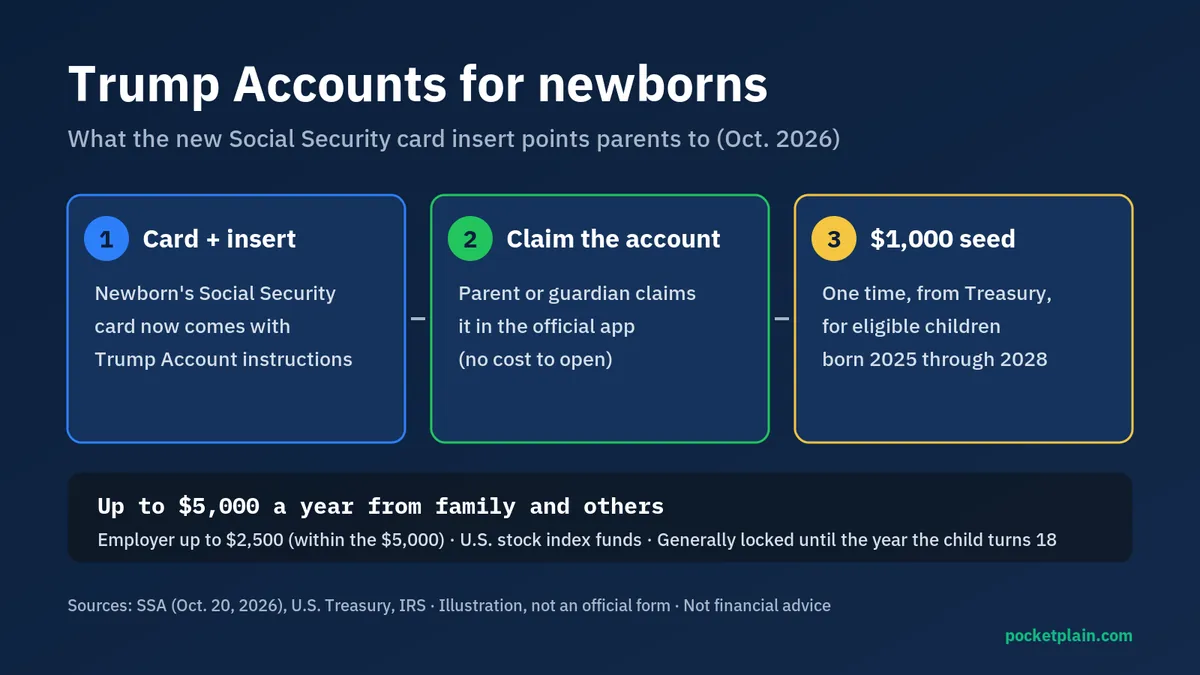
Parents of newborns will now find instructions for a Trump Account in the same envelope as their baby's Social Security card. The Social Security Administration said on Oct. 20, 2026, that cards issued through its Enumeration at Birth program now include an insert on how to claim the child's account in the official Trump Accounts app. Eligible children born from 2025 through 2028 may receive a one-time $1,000 from the Treasury. SSA announcement
Enumeration at Birth lets parents request a Social Security number for their baby as part of registering the birth. State vital statistics offices send the information to SSA electronically, and SSA assigns the number and issues the card.
What the new insert tells parents
According to SSA, the insert directs parents and guardians to:
- Visit TrumpAccounts.gov to download the Trump Accounts app and sign up.
- Watch for a message from the Treasury about activating the account and receiving the $1,000 contribution, if the child is eligible.
- Manage the account and, if they want, add money, subject to the annual limits.
SSA also said that nearly 70 million Trump Accounts are open for eligible children and that 26 million have already received contributions, including donor contributions to some accounts that parents haven't claimed yet.
Your child may already have an account
On Oct. 1, 2026, the Treasury said automatic enrollment was complete: every eligible child under 18 with a valid Social Security number now has a Trump Account. Treasury Secretary Scott Bessent said more than 60 million children were added that way. Treasury, automatic enrollment
An account that was opened automatically still has to be claimed by a parent or guardian. Until then, you can't manage it, and family members, friends and employers can't contribute. Eligible children also need a claimed account to receive the $1,000 seed money.
To claim it, the Treasury says to download the official app for iOS or Android. You'll verify your identity and your relationship to the child, review the child's information and accept the account terms. The IRS also lets parents elect an account by signing in to their IRS online account with ID.me and submitting Form 4547; it estimates that process takes 5 to 10 minutes. IRS Trump Accounts page
There is no cost to open an account, according to the Treasury. When it began activating accounts, it said the first activation emails would come only from no-reply@TrumpAccounts.Treasury.gov and pointed families to the official app when in doubt. Treasury, app launch Be wary of texts or emails that ask for a fee or for your Social Security number through a link.
Who gets the $1,000
The $1,000 pilot program contribution is for children who:
- were born from Jan. 1, 2025, through Dec. 31, 2028;
- are U.S. citizens; and
- have a valid Social Security number.
Older children can have a Trump Account too, if they haven't turned 18 before the end of the year the account is elected, but they don't get the $1,000. IRS, IR-2025-117
Contribution limits and investment rules
| Rule | What the IRS says |
|---|---|
| Treasury seed | $1,000, one time, for eligible children born 2025–2028 |
| Family and other personal contributions | Up to $5,000 a year per child, combined |
| Employer contributions | Up to $2,500 a year, counted within the $5,000; not taxable income to the employee |
| Government and charity contributions | Allowed for qualifying groups of children; not subject to the annual limit |
| Inflation adjustment | Limits adjust after 2027 |
| Earliest contributions | July 4, 2026 |
The money must be invested in mutual funds or ETFs that track an index made up mainly of U.S. companies, such as the S&P 500. Under the IRS's Notice 2025-68, an eligible fund can't use leverage or charge annual fees and expenses above 0.1% of the balance. IRS Notice 2025-68 Temporary IRS regulations on Trump Accounts also took effect on Sept. 30, 2026. Federal Register
The child doesn't need earned income for anyone to contribute, which is different from a regular IRA. But no one gets a tax deduction for putting money in. The notice says personal contributions create "basis" in the account, while the $1,000 seed, employer money and government or charity contributions don't. In IRA terms, basis is the part that has already been taxed.
If you're weighing this against other ways to save for a child, our explainers on index funds vs. ETFs and Roth vs. traditional IRAs cover the building blocks.
When the money can come out
Under Notice 2025-68, nothing can generally be withdrawn before Jan. 1 of the year the child turns 18, apart from limited exceptions such as rollovers to another Trump Account or an ABLE account. After that, the account is generally treated like a traditional IRA, with similar tax rules. IRS, Working Families Tax Cuts Notice 2025-68 adds that this includes the possibility of a 10% additional tax on early distributions if no exception applies.
That makes the Trump Account a long-term account, not a fund you can tap for a child's expenses in the meantime. For comparison, adult IRA limits are a separate set of rules: see our guide to the 2026 401(k) and IRA limits.
What to do now
- If you had a baby recently, look for the insert with the Social Security card and claim the account in the official app.
- If your child is older, check the app: Treasury says eligible children already have an account waiting to be claimed.
- Before adding your own money, decide how it fits with your emergency savings and other goals. The $1,000 seed doesn't require any contribution from you.
- Protect your information. Use only the official app, TrumpAccounts.gov or IRS.gov. Our reminder on protecting your tax data explains common scams.
Sources
- Social Security Administration: press release on Trump Account inserts for newborns, Oct. 20, 2026.
- U.S. Department of the Treasury: press releases on automatic enrollment (Oct. 1, 2026) and the app launch (May 28, 2026).
- Internal Revenue Service: Trump Accounts page; IR-2025-117; Notice 2025-68; Working Families Tax Cuts provisions page.
- Federal Register: Trump Accounts temporary regulations (TD 10056), Sept. 30, 2026.
All sources were checked on Oct. 21, 2026.
This content is for general education and is not financial advice.