The Centers for Medicare & Medicaid Services (CMS) proposed a rule on Oct. 16, 2026, that would make Medicare Advantage plans check their provider directories far more often and would limit what you pay when a wrong listing sends you to an out-of-network doctor. The changes would begin in 2028, so they don't cover the plans people are comparing during this fall's Open Enrollment. CMS announcement
The proposal, file code CMS-4214-P, carries out parts of the Consolidated Appropriations Act, 2026, signed into law on Feb. 3, 2026. Besides the directory rules, which come from a section called the REAL Health Providers Act, it would drop one prescription copay to $0 for certain low-income enrollees and add new reporting rules for pharmacy benefit managers in Medicare Part D. CMS fact sheet
What CMS proposed for provider directories
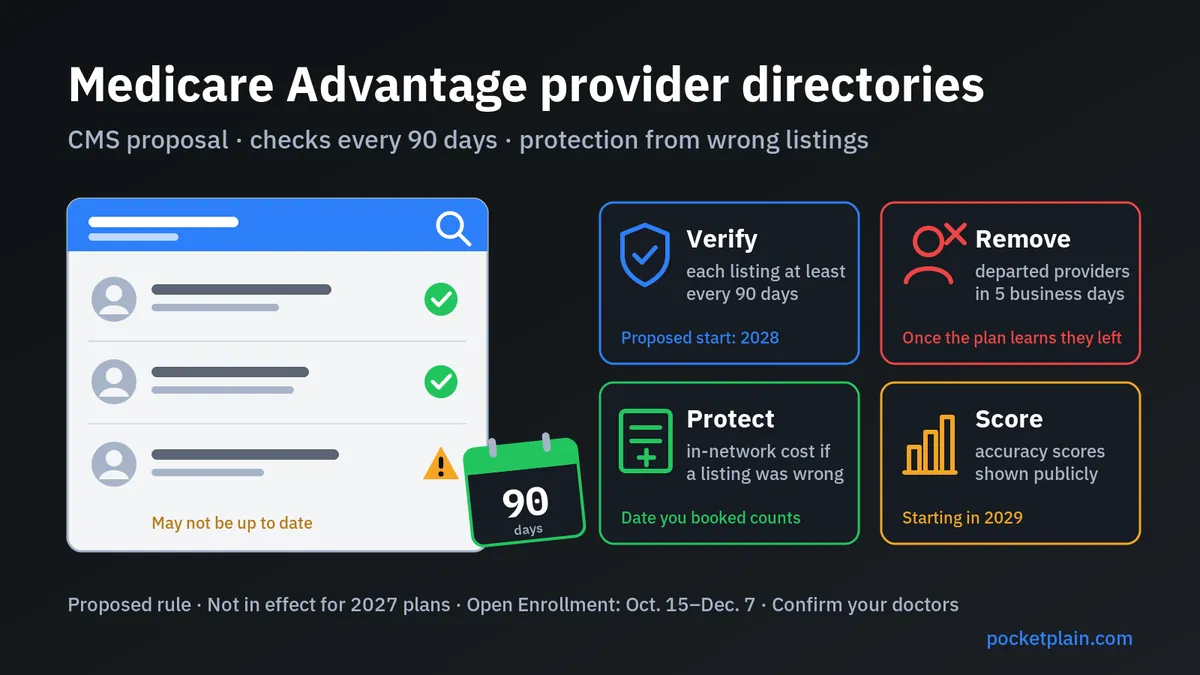
A provider directory is the plan's list of doctors, hospitals and other providers in its network. Starting with plan year 2028, each Medicare Advantage plan covered by the rule would have to:
- Keep an accurate directory on a public website.
- Verify each listed provider's information at least once every 90 days. For hospitals and certain other facilities, the HHS secretary could set a longer interval, but no longer than 12 months.
- Flag a listing as possibly out of date when the plan can't verify it.
- Remove a provider within 5 business days after determining the provider has left the network.
- Run a yearly accuracy analysis and report an accuracy score to CMS.
Current rules already require plans, for plan years beginning in 2026, to send directory information to CMS for Medicare Plan Finder, update it within 30 days of learning of a change, and attest to its accuracy at least once a year. The proposal adds the 90-day verification standard and the scoring on top of that, according to the proposed rule. The Federal Register published the official version on Oct. 20, 2026 (91 FR 66408).
Protection if a wrong listing sends you out of network
The proposal's most direct money protection works like this: if a provider was listed as in-network in the plan's online directory on the date you made the appointment, but turns out to be out-of-network when you get care, the plan would have to limit your cost sharing to the lesser of the in-network amount or the amount that would otherwise apply. The service would have to be one the plan would cover from an in-network provider.
Key details in the proposed rule:
- How to ask: you or an authorized representative could request the protection verbally or in writing. The plan would handle it as an organization determination or reconsideration, and it would have to apply the protection on its own when it knows, or reasonably should know, that it applies.
- Which date counts: the earliest date the appointment was scheduled, even if you reschedule later.
- Proof: the plan would check the provider's scheduling records and its own archived directory. If it can't get that documentation within the required time frames, the protection would apply in your favor unless the plan can clearly show it doesn't.
- Money back: if you already paid more, the plan would refund the excess, and the amount would count toward your in-network maximum out-of-pocket limit.
The rule would cover network-based Medicare Advantage plans, such as HMOs, PPOs and special needs plans, plus private fee-for-service plans that use a network. It would not apply to PACE plans or to regional PPOs that meet access requirements mainly without written provider contracts. CMS is also asking for comments on whether an up-to-date printed directory should count the same way as the online one. Plans would have to describe the protection in plain language in their directories, starting with the fall enrollment period for 2028 coverage.
Accuracy scores you could see starting in 2029
Plans would report their 2028 directory accuracy scores to CMS by April 2029. Starting with plan year 2029, CMS would post the scores in a machine-readable file on its website, and each plan would have to display its most recent score prominently in its provider directory. CMS says it is also considering showing the scores on Medicare Plan Finder.
Drug-plan changes in the same proposal
Two other parts of the proposal affect Medicare Part D:
| Proposed change | Who it would affect | Would start |
|---|---|---|
| Generic drug copay would drop to $0 | Full-benefit dual eligible enrollees with incomes at or below 100% of the federal poverty level; CMS estimates about 6 million enrollees | Plan years beginning on or after Jan. 1, 2028 |
| Pharmacy benefit manager (PBM) reporting and pay rules | PBMs and their affiliates working for Part D plans | Contract year 2028 |
For 2026, that group pays $1.60 for generics and $4.90 for other covered drugs, with no deductible, according to the proposed rule. Only the generic copay would change. For PBMs, CMS says they would have to report their compensation and cost performance to plan sponsors and CMS each year, and their pay would have to reflect fair market value for their services rather than drug costs. CMS says it can't estimate the financial impact of the PBM changes because of limited data on PBM contracts.
What it means for Open Enrollment now
Medicare Open Enrollment runs from Oct. 15 to Dec. 7. If you join or switch plans, the new coverage starts Jan. 1, and the plan must receive your request by Dec. 7. People already in a Medicare Advantage plan get another window from Jan. 1 to March 31 to switch plans or return to Original Medicare. Medicare.gov enrollment periods
Because the directory protections would begin in 2028 and are only proposed, they don't apply to 2027 coverage. Medicare's own provider network fact sheet explains why checking still matters:
- A plan can add or remove providers at any time during the year, and a provider can leave a network at any time.
- Plans should make a good-faith effort to give you at least 30 days' notice that your provider is leaving the network, and your plan will notify you if a provider you see regularly, like your primary care doctor, is leaving.
- Medicare suggests checking each Open Enrollment that your providers are in the plans you're considering, and confirming with the provider's office that it's still in your network when you book.
If you think a network change will interrupt your care and put your health at risk, Medicare's fact sheet says to call 1-800-MEDICARE (1-800-633-4227); TTY users can call 1-877-486-2048. To compare plans, you can use Medicare.gov/plan-compare.
Medicare's fact sheet also suggests asking each plan how to find out whether your providers are in the network, what you pay in network and out of network, and what happens if you need covered treatment that no in-network provider offers. Our own suggestion: when you book with a new provider, save the appointment confirmation and a dated screenshot of the directory listing. That won't trigger any protection in 2027, but it gives you a record if a billing question comes up.
How to comment and what happens next
To be assured consideration, comments must be received by 5 p.m. Eastern Standard Time on Dec. 15, 2026, according to the proposed rule's Federal Register notice. You can submit them online through Regulations.gov docket CMS-2026-3533 or by mail, citing file code CMS-4214-P. The Federal Register notice lists docket CMS-2026-2533, but Regulations.gov files this proposal under CMS-2026-3533. Comments are posted publicly, including any personal information you include.
A proposed rule can change before it's final. CMS also said it expects to release a separate proposed rule with other Medicare Advantage and Part D policy and technical changes later this fall.
Related reading
For another 2027 change that affects retirees, see our coverage of the 2027 Social Security cost-of-living adjustment. If you're still working and saving in a health savings account, our HSA limits and eligibility guide explains how Medicare enrollment can affect contributions. Planning a trip abroad? Our travel insurance guide covers where Medicare usually stops. To prepare for out-of-pocket medical bills, read how much emergency fund you need, and for longer-term saving, see the 401(k) and IRA contribution limits.
Sources
- Centers for Medicare & Medicaid Services: press release "CMS Proposes Reforms to Strengthen Transparency and Affordability in Medicare Advantage and Part D," Oct. 16, 2026.
- Centers for Medicare & Medicaid Services: fact sheet on CMS-4214-P, Oct. 16, 2026.
- Federal Register: proposed rule CMS-4214-P, document 2026-21420, published Oct. 20, 2026 (91 FR 66408).
- Regulations.gov: docket CMS-2026-3533 (proposed rule CMS-4214-P).
- Medicare.gov: "Joining a plan" (enrollment periods).
- Medicare.gov: "Understanding Your Medicare Advantage Plan's Provider Network," CMS Product No. 11941, May 2026.
All sources were checked on Oct. 20, 2026.
This content is for general education and is not financial, legal or health insurance advice. Check a plan's current terms with the plan and Medicare before enrolling.