A personal loan gives you a lump sum that you pay back in fixed amounts, called installments, over a set period. The Consumer Financial Protection Bureau (CFPB) describes these as closed-end loans: the lender gives you all of the money at the beginning, and the payments are generally the same for the life of the loan. People use them for a large purchase, an unexpected expense or to consolidate existing debt. They can range from several hundred dollars to several thousand dollars or more, and their terms from a few months to several years. CFPB on personal installment loans
What a loan really costs comes down to the rate, the fees and the length of the term. This guide explains how each one works, what the lender has to show you before you sign and which offers to walk away from.
How lenders set your rate and terms
When you apply, most lenders weigh these factors to decide your interest rate and loan terms, according to the CFPB:
- Your credit score and credit reports
- Your income
- Your existing debts
- The amount and length of the loan
- The interest rates your state's law permits
- Other factors, such as your bank account transactions
Personal loan rates can be fixed or adjustable, so check which one an offer uses. Because lenders look at your credit, it's worth looking at your reports before you apply; our guide on how to read your credit report walks through each section.
For a benchmark, the Federal Reserve's G.19 consumer credit release of Oct. 7, 2026, put the average rate on 24-month personal loans at commercial banks at 11.90% for August 2026, the survey month for the third quarter; the figure is marked preliminary and can be revised. The same table shows 21.19% across all credit card accounts. Both figures are APRs as defined by Regulation Z. The personal loan figure is a simple average of each bank's most common rate during the first calendar week of the quarter's middle month, so it is a market reference, not a quote: the survey covers commercial banks only, and your own offer could be higher or lower. Federal Reserve G.19 release
Interest rate vs. APR
The interest rate is what you pay the lender for borrowing the money, on top of the amount you borrowed (the principal). The annual percentage rate (APR) is the interest rate plus additional fees charged by the lender, including origination charges and other fees charged when the loan is made. Both are expressed as percentages, but they measure different things. The CFPB's advice is to compare APRs with APRs, not an APR with an interest rate. CFPB on interest rate vs. APR
The CFPB also notes that a higher credit score generally means lower rates, but lenders aren't required to offer you the best rate available. Its answer: the best way to reduce your costs is to shop around and compare lenders. For how APR applies to card balances, see how credit card APR works.
Fees to check before you accept
Fees and charges are often added to the total cost of a personal installment loan, the CFPB says. Common ones include:
- An origination fee
- A documentation fee, to process the paperwork
- Credit insurance and disability insurance, which are generally optional
- Non-filing insurance, if the loan is secured by collateral
- Late fees
The CFPB recommends checking the required loan disclosures and loan documents for any fees you may owe before you agree to the loan, and comparing offers from several lenders. CFPB on personal loan fees If an insurance product is optional, ask how much it adds to the payment and to the total cost before you decide.
Example: what a $5,000 loan can cost
Illustrative scenario. The rate, fee and terms below are hypothetical, not offers. Pocket Plain calculated the payments with a standard monthly amortization formula, and the results are rounded.
Say you borrow $5,000 at a fixed 12% interest rate:
| Scenario | Monthly payment | Total interest and fees | APR |
|---|---|---|---|
| 24 months, no fees | about $235 | about $649 | 12% |
| 36 months, no fees | about $166 | about $979 | 12% |
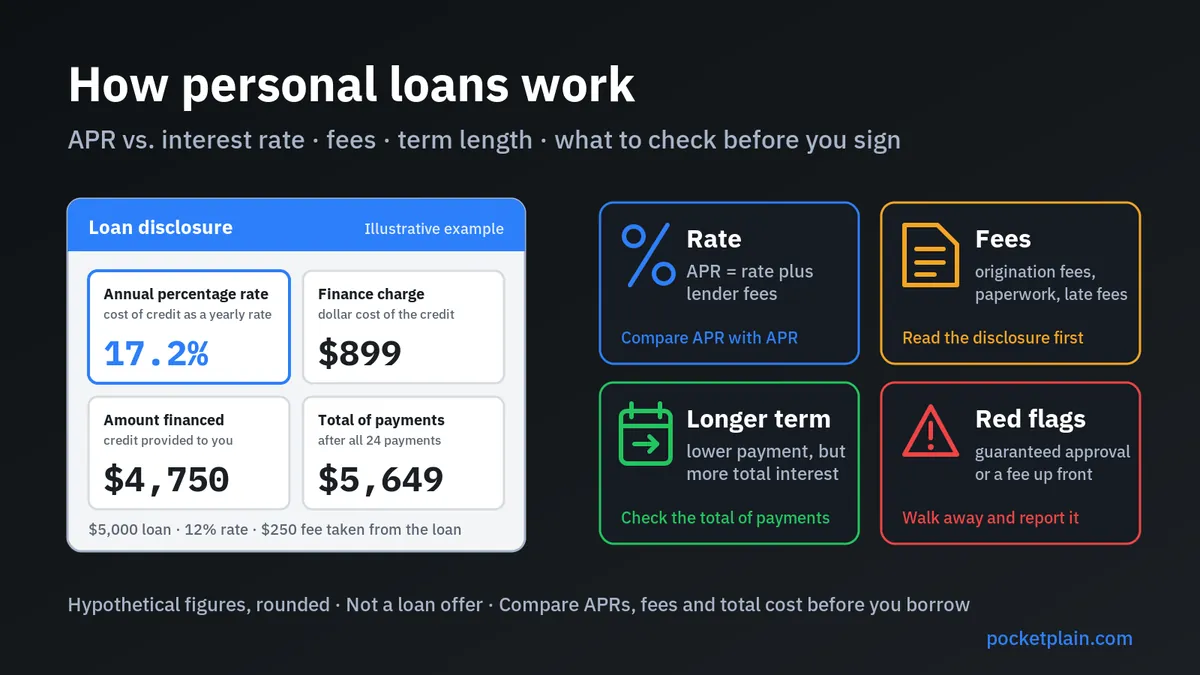
| 24 months, $250 origination fee taken out of the loan (you receive $4,750) | about $235 | about $899 | about 17.2% |
Two lessons follow. A longer term lowers the monthly payment but raises the total you pay. And a fee deducted from the money you receive leaves the payment unchanged while pushing the APR well above the interest rate, because you repay a $5,000 loan, with interest, after receiving only $4,750. That gap is why the APR, not the interest rate, is the better number for comparing offers.
What the lender must disclose before you sign
The federal Truth in Lending Act requires lenders to give you specific disclosures about the important terms of your loan, including the APR. For a closed-end loan like a personal loan, Regulation Z lists what that disclosure must contain, as it applies to your loan. Key items include:
- Amount financed: the amount of credit provided to you or on your behalf.
- Finance charge: the dollar amount the credit will cost you.
- Annual percentage rate: the cost of your credit as a yearly rate.
- Payment schedule: the number, amounts and timing of your payments.
- Total of payments: what you will have paid once you make all scheduled payments.
- Prepayment: a definite statement of whether you'll owe a penalty if you pay the loan off early or, for some loans, whether you'd get a rebate of part of the finance charge.
- Late payment: any dollar or percentage charge for a late payment.
- Security interest: whether the lender has or will get a security interest in property, meaning the loan is backed by collateral.
The rule's official commentary shows how a fee changes the amount financed: on a $2,500 loan where the lender withholds a $40 loan fee from the money it advances, the amount financed is $2,460. Regulation Z § 1026.18 When you line up two offers, compare the APR, the finance charge and the total of payments, not only the monthly payment.
Don't expect a federal cooling-off period. Regulation Z's right to rescind, which generally lets you cancel within three business days, applies to credit secured by your principal dwelling, so an unsecured personal loan doesn't come with that right. Regulation Z § 1026.23
How applying can affect your credit
A lender that checks your credit report after you apply makes what's called a hard inquiry. Hard inquiries affect your credit scores because most scoring models look at how recently and how often you apply for credit. Soft inquiries, such as prescreening by prospective lenders and your own requests for your credit reports, don't affect your scores. The nationwide credit reporting companies let you see your reports every week if you ask. CFPB on credit inquiries Before you check rates with a lender, ask whether that step uses a soft or a hard inquiry. For how inquiries fit into the bigger picture, see our explainer on credit reports vs. credit scores.
Think twice before you cosign
If someone asks you to cosign their personal loan, the Federal Trade Commission (FTC) spells out what that means: you agree to be responsible for someone else's debt, and if the main borrower misses payments or defaults, you must pay. By law, the lender must give you a Notice to Cosigner, which warns that you may have to pay up to the full amount plus late fees or collection costs, and that the creditor can collect from you without first trying to collect from the borrower, though some states require creditors to try the borrower first.
Cosigning gives you no ownership of what the loan pays for. The creditor can report the loan as your debt, late payments by the borrower can show up on your credit report, and the obligation may keep you from getting credit even if the borrower pays on time. The lender and the borrower would both have to agree to release you later. FTC cosigning FAQs
Payday loans and credit union alternatives
A payday loan is a different product. The CFPB describes it as a short-term, high-cost loan, generally for $500 or less, usually repaid in one payment on your next payday, typically two to four weeks after you borrow. Payday lenders generally don't check whether you can repay while meeting your other bills. A typical two-week payday loan with a $15 fee per $100 borrowed equals an APR of almost 400%, compared with about 12% to about 30% on credit cards. CFPB on payday loans
Federal credit unions can offer a smaller, cheaper option called a payday alternative loan (PAL). Under the terms MyCreditUnion.gov describes, you must have been a member for at least one month, PALs run from $200 to $1,000 for one to six months, the application fee can't be more than $20 and must reflect actual processing costs, and you can get up to three PALs in six months as long as none overlap or are rolled over. The same page compares a PAL at 28% APR with an 18% maximum APR on other federal credit union loans. MyCreditUnion.gov on PALs A second version, PALs II, allows up to $2,000 and terms up to 12 months, according to the National Credit Union Administration (NCUA). NCUA letter 20-CU-15 Ask your credit union which version, if any, it offers.
Red flags: advance-fee loan scams
In an advance-fee loan scam, someone promises you a loan no matter your credit history, then asks you to pay first, for "processing," "insurance," an "application" or something else. There is no loan, the FTC says, and the scammer disappears with your money. These scams target people who have bad credit or trouble getting a loan for other reasons, and scammers often buy lists of people who searched or applied online for payday or other loans.
Warning signs drawn from the FTC's guidance:
- A guarantee before you apply. Legitimate lenders check your credit report, confirm your application and decide whether you can repay before making a firm offer. Real lenders can charge an application or appraisal fee, but no legitimate lender says paying a fee guarantees a loan.
- An upfront fee to release the money. Any fee a lender wants before granting the loan, especially for "insurance," "processing" or "paperwork," is a cue to walk away.
- A loan offered by phone with payment up front. It's illegal for telemarketers to promise you a loan and ask you to pay for it before they deliver.
- Payment by wire transfer, gift card or cryptocurrency. Scammers ask for payment methods that make it hard to get your money back.
The FTC suggests checking that the lender is registered in your state through your state attorney general or banking regulator, and searching the company's name with words like "complaint" or "scam." Report losses at ReportFraud.ftc.gov. FTC on advance-fee loans
If you can't make a payment
If you can't make a payment, the CFPB says to contact your lender as soon as possible to ask about options, which may include deferment, forbearance or a payment plan. If you miss payments, the lender may turn to debt collectors and may report your payments to one or more of the three major credit reporting companies, Experian, Equifax and TransUnion, and late payments can significantly affect your credit scores.
If you're weighing a loan to consolidate several debts, compare it with a repayment plan first; our comparison of the debt snowball and avalanche methods shows how each orders extra payments. And if you're borrowing to cover surprise bills, our guide to how much emergency fund you need can help you build a cushion for the next one.
If you're planning to buy a home, our guide to how much house you can afford walks through the monthly payment, debt-to-income ratio and cash for closing.
Sources
- Consumer Financial Protection Bureau: "What is a personal installment loan?"
- Board of Governors of the Federal Reserve System: Consumer Credit - G.19, August 2026, released Oct. 7, 2026.
- Consumer Financial Protection Bureau: "What is the difference between a loan interest rate and the APR?"
- Consumer Financial Protection Bureau: "Do personal installment loans have fees?"
- Consumer Financial Protection Bureau: Regulation Z, § 1026.18, Content of disclosures, with official interpretation.
- Consumer Financial Protection Bureau: Regulation Z, § 1026.23, Right of rescission.
- Consumer Financial Protection Bureau: "What is a credit inquiry?"
- Federal Trade Commission: "Cosigning a Loan FAQs."
- Consumer Financial Protection Bureau: "What is a payday loan?"
- National Credit Union Administration (MyCreditUnion.gov): "Payday Alternative Loans."
- National Credit Union Administration: Letter to Credit Unions 20-CU-15, "Principles for Making Responsible Small-Dollar Loans," May 2020.
- Federal Trade Commission: "What To Know About Advance-Fee Loans," July 2022.
All sources were checked on Oct. 18, 2026.
This content is for general education and is not financial or legal advice. Check a lender's current terms and your loan disclosures before you borrow.