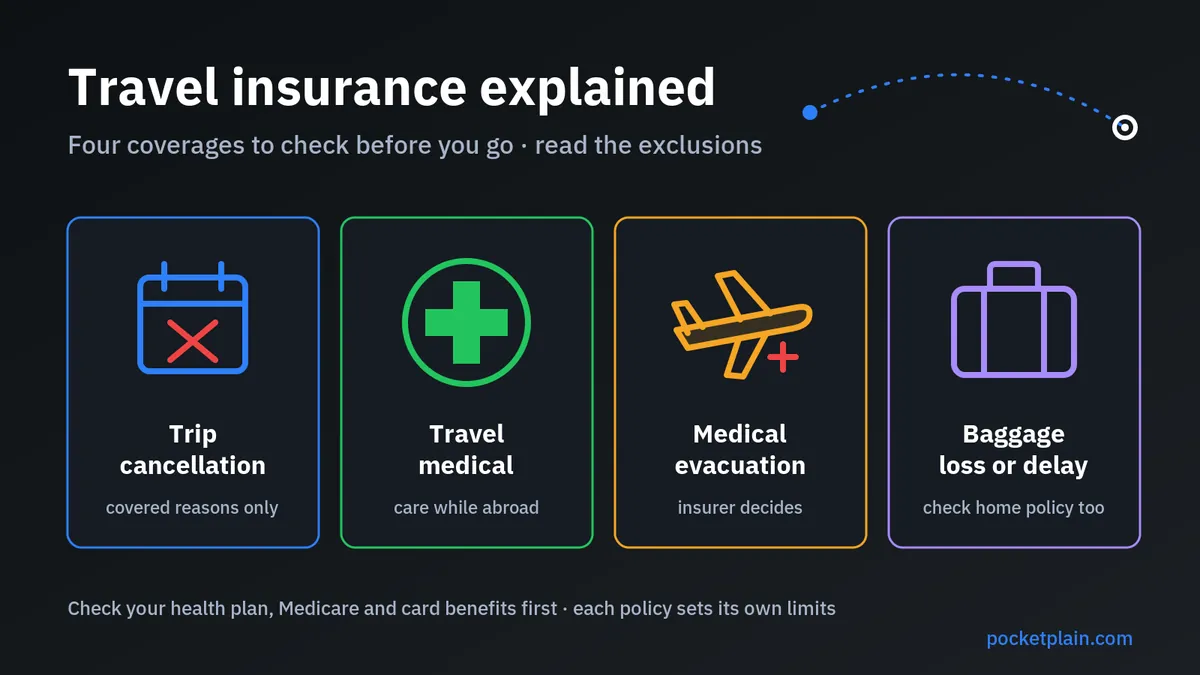
Travel insurance is not one product. It is a bundle of separate coverages that can pay you back for a canceled trip, medical care while you travel, an emergency evacuation, or lost bags, and each policy decides for itself which situations count. Before buying anything, check what your health plan, Medicare, and credit card already cover, then compare policies on what they exclude as much as on what they include. This guide walks through each piece using guidance from the State Department, the CDC, Medicare, and state insurance regulators.
Compare travel insurance quotes
What travel insurance does and doesn't do
The National Association of Insurance Commissioners (NAIC), the organization of state insurance regulators, describes travel insurance as protection that covers some or all travel-related costs, including flights, lodging, and medical emergencies, if a trip is canceled or interrupted. It also stresses that each policy sets its own limits and lists specific situations it will or won't cover. NAIC: Should I Get Travel Insurance?
That second point is the one to hold on to. Two policies sold under the same label can behave very differently when you file a claim, so the policy wording matters more than the name on the brochure.
The NAIC is also direct about the decision itself: only you can decide if travel insurance is right for you. Its suggested questions include whether you are willing to lose money if you must cancel, whether you could pay for rebooking, how likely severe weather is, and whether you or a loved one is dealing with a health issue.
The main types of coverage
Policies mix and match these coverages. Some are sold together as a package; others can be bought separately. CDC Yellow Book
| Coverage | What it generally does | Watch for |
|---|---|---|
| Trip cancellation, interruption, and delay | Pays you back for prepaid trip costs if you cancel or cut a trip short for a reason the policy covers. | It usually does not pay for medical costs in other countries. State Department |
| Travel medical | Pays for short-term medical care if you get sick or injured while traveling. | Whether you need the insurer's approval before getting care, and whether pre-existing conditions are excluded. |
| Medical evacuation and repatriation | Pays for emergency flights or transport to the nearest hospital that can treat you, and later transport home if needed; repatriation covers the return of remains. | The decision to evacuate is made by the insurance company, not at the traveler's request. |
| Baggage loss or delay | Pays for the loss of baggage or personal items. | Your homeowners policy may already cover belongings lost or stolen while traveling. |
| Accidental death and dismemberment | Pays your beneficiaries if you die in an accident during the trip, or pays you for certain accidental losses such as a limb or eyesight. | Decide whether you need it alongside any life or accident coverage you already have. |
The covered reasons for trip cancellation are spelled out in each policy. The NAIC's examples include you or a travel companion getting sick or injured with a doctor saying you're not well enough to travel, a family member who isn't traveling with you being hospitalized or dying, severe weather or an issue with your airline, train, or cruise line, a natural disaster at home or at your destination, an overnight flight delay, and being legally required to serve on a jury or testify in court.
Check the coverage you already have
Both the CDC and the State Department start from the same place: find out what your existing insurance does abroad before you buy more. State Department: Medicine and Health
Your health plan. Some U.S. health plans cover medical emergencies abroad, but the CDC notes that domestic insurance may cover medical expenses only under specific circumstances and may not cover the costs of canceling all or part of a trip. The State Department suggests asking your insurer whether it covers emergency and routine care abroad, and, if your plan is accepted overseas, taking your insurance card and claim forms with you.
The U.S. government. The State Department is blunt: the U.S. government does not pay medical bills abroad, and you are responsible for all hospital and medical costs.
Medicare. Medicare usually doesn't cover health care while you're traveling outside the U.S., though there are limited exceptions, and in most cases you pay all of the costs. Medicare drug plans don't cover prescription drugs you buy outside the U.S. Medicare.gov The exceptions are narrow; for example, Medicare may cover a foreign hospital when you're in the U.S. during an emergency and that hospital is closer than the nearest U.S. hospital that can treat you. Medicare also points out that travel insurance doesn't necessarily include health insurance, so read the conditions carefully.
Some Medigap (Medicare Supplement) policies cover emergency care when you travel outside the U.S. Medicare.gov: What Medigap covers The CDC Yellow Book summarizes that coverage: Medigap plans C, D, F, G, M, and N cover some emergency care abroad if it begins during the first 60 days of a trip; after a yearly $250 deductible, plans may cover 80% of billed charges for certain medically necessary emergency care, up to a $50,000 lifetime maximum, and only if Medicare doesn't otherwise cover the care. Plans C and F can't be bought by people who became eligible for Medicare on or after January 1, 2020; if you were eligible before that date, you may still be able to buy one even if you haven't enrolled yet. Medicare.gov: Compare Medigap Plan Benefits The CDC adds that Medicare Advantage plans don't usually cover treatment outside the U.S., though some include emergency care, so check your plan.
Your credit card. The NAIC notes that some credit cards offer trip cancellation and lost baggage coverage. The CDC says these benefits vary widely in whom and what they cover, some require you to enroll, and nearly all require a formal claim with no guarantee of reimbursement. It recommends reading the card's guide to benefits and not treating card benefits as a substitute for travel health, medical evacuation, or trip disruption insurance. For how card accounts and their terms work in general, see how credit cards work.
Your home and car insurance. The NAIC says most homeowners policies cover personal property lost or stolen while traveling; confirm with your insurer. If you plan to drive abroad, the State Department warns that your U.S. auto insurance might not cover you there.
Exclusions and fine print to read first
Every policy is different, but the NAIC lists some of the most common exclusions:
- Pre-existing health conditions
- Pandemics
- Civil and political unrest at your destination
- Pregnancy and childbirth
- Activities such as bungee jumping, backcountry skiing, and snowboarding
Pre-existing conditions. The CDC says conditions that required hospitalization or direct medical intervention in the 90 days before departure are often excluded, and that travelers over 75 should start looking for specialized policies early because coverage for underlying conditions is harder to obtain. If you have a condition, the CDC suggests discussing it with the insurer before you leave.
Cancel for Any Reason (CFAR). With CFAR, the reason you cancel doesn't matter. But the NAIC describes it as usually an add-on to a standard trip cancellation policy that costs more, typically reimburses only a portion of your trip expenses, must usually be bought within a set period after booking, and generally requires you to insure all of your prepaid, nonrefundable trip costs.
Timing. Buying early may help. The NAIC warns that if you wait until a storm has already been named, your policy likely won't cover claims related to it.
Approval rules. The NAIC suggests asking whether you need your insurer's approval before getting medical care. The CDC's list of questions to ask includes whether you need preauthorization, whether you need a second opinion before emergency treatment, and how out-of-network care is handled.
What it can cost, according to official sources
Pocket Plain doesn't quote prices for specific policies; premiums depend on the trip and the traveler. Official sources give these general ranges:
- The NAIC says policies usually cost 5% to 10% of the total trip price, depending on the season, where you're going, your age, and other factors.
- The CDC Yellow Book says "comprehensive" policies that combine trip disruption with travel health and evacuation coverage can cost up to 8% of the trip cost with a list of covered cancellation reasons, and up to 15% with cancel-for-any-reason coverage.
The cost of going without can be much larger when it comes to evacuation. The State Department says most health plans don't pay for an air ambulance back to the U.S., and that such an evacuation can cost from $20,000 to $200,000 depending on where you are and your condition. The CDC gives a range from $25,000 for transport within North America to over $250,000 for more distant and remote locations.
A policy's price is one line in your trip budget. If a canceled trip or a medical bill abroad would push you onto a credit card, an emergency fund is the backstop that insurance doesn't replace. Our guide to how much to keep in an emergency fund can help you size one.
How to compare travel insurance policies
Start with your trip, not the policy. Where are you going, for how long, what have you prepaid that you can't get back, and what does your existing coverage leave out? Then compare policies on the points official sources flag.
The State Department's checklist says to make sure a policy covers:
- The countries you plan to visit
- The length of your trip
- Emergency medical care
- Medical transportation back to the United States
- Travel and lodging expenses
- Cash for emergencies
- All current medical conditions for you and your family
- Activities you plan to take part in
It also suggests checking whether the insurer has a 24-hour help line. The CDC adds features to look for in travel health and evacuation coverage, such as arranging direct payment with hospitals, a 24-hour physician-backed support center, transport home or to an equivalent facility, and coverage for high-risk activities like scuba diving.
Before you buy, the NAIC recommends asking your insurance agent or company exactly what a policy covers, including its limitations and exclusions. Many booking platforms offer insurance at checkout, so it's worth deciding what you need before you reach that screen.
The CDC notes that third-party websites let you compare available policies side by side, and that it does not endorse any provider. If you want to line up quotes in one place, you can compare travel insurance quotes with HelloSafe (affiliate link). Whichever tool you use, read the full policy wording for the plan you choose; a comparison table is a starting point, not the contract.
If you need care abroad
Even with insurance, expect to pay first in many places. The State Department says payment or a deposit is often required before services are provided. The CDC says care abroad usually requires cash or a card payment at the point of service, and that travelers should keep copies of all charges and receipts and submit them to the insurer afterward.
Putting a large medical bill on a card can be the practical option, but a balance you carry starts accruing interest under your card's terms. Our explainer on credit card APR covers how that works. Keeping trip money in a separate high-yield savings account is one way to have cash ready.
If you or a U.S. citizen you're traveling with becomes seriously ill or injured, the State Department can help find local doctors or hospitals, contact family or friends with your permission, and explain options for sending money.
Compare travel insurance quotes
Where to get help or file a complaint
Travel insurance is regulated by the states. The NAIC says your state or territory's insurance department can answer questions about travel insurance.
If a claim is delayed or denied, the NAIC's advice is to try to resolve it with your insurer first. If that fails, your state department of insurance can investigate complaints for free, including unfair claim delays or denials, failure to honor your policy, and violations of state insurance laws. NAIC: How to File a Complaint It suggests gathering your policy number, bills, and records, keeping a log of all communication with the insurer, using language from your policy, and stating the outcome you want.
After a complaint is accepted, the department forwards it to the insurer, which must respond; if the department finds the insurer acted improperly, it can require the company to correct the problem. You can find your state's insurance department and its complaint page in the NAIC directory.
Sources and how this guide was made
- U.S. Department of State: Travel Insurance and Medicine and Health (both last updated Aug. 11, 2025).
- Medicare.gov: Travel outside the U.S., what Medigap covers, and Compare Medigap plan benefits.
- CDC: Yellow Book 2026, travel insurance chapter.
- NAIC (state insurance regulators): Should I Get Travel Insurance? (June 16, 2026), How to File a Complaint, and the insurance departments directory.
All sources were checked on Oct. 17, 2026. This guide describes general features of travel insurance in the U.S.; it does not review or rank any insurer or policy, and coverage, prices, and rules vary by policy and state. The HelloSafe link is an affiliate link; it does not change what this guide says.
This content is for general education and is not financial advice. Read your policy documents and ask the insurer about your situation before you buy.