How much house you can afford comes down to two numbers you control: the total monthly home payment that fits your budget and the cash you can put in at closing without emptying your savings. A lender's preapproval tells you how much it is willing to lend. It doesn't tell you what you can comfortably pay every month after taxes, insurance, repairs and your other goals. This guide walks through the math in the order the Consumer Financial Protection Bureau (CFPB) suggests, with a fully worked hypothetical example.
Step 1: Price the total monthly home payment
The CFPB's homebuying guide says your total monthly home payment includes mortgage principal, interest, property taxes, mortgage insurance, homeowners insurance, supplementary insurance such as flood coverage, and homeowners' association (HOA) fees. Taxes and insurance can go up over time. On top of that payment, the CFPB says to budget for maintenance, repairs and utilities, which can be significant and vary widely by location, climate and the home itself. CFPB: Figure out how much you want to spend
Many lenders collect property taxes and insurance through an escrow account, so you pay a slice every month instead of one large bill. Because those bills can change from year to year, your escrow payment and your total monthly payment can change too, even on a fixed-rate loan. CFPB on escrow accounts
A practical way to find your number is to look at what you actually spend now, then decide how much of your take-home pay can go to housing while you keep saving for emergencies and other goals. If you're not sure where your money goes, our emergency fund guide shows how to size the cushion you'll want to keep after you buy.
Step 2: Check your debt-to-income ratio
Lenders look at your debt-to-income ratio (DTI): all your monthly debt payments divided by your gross monthly income, which is your pay before taxes and other deductions. The CFPB's own example is $2,000 of monthly debt payments on $6,000 of gross monthly income, a DTI of 33%. Different loan products and lenders have different DTI limits, so there isn't one cutoff that applies to everyone. CFPB: What is a debt-to-income ratio?
To run it for a home purchase, add the new total home payment to the debts you already have, such as car loans, student loans and minimum credit card payments. If your DTI looks high, paying down a balance before you apply can help more than stretching for a bigger loan. Our guide to debt snowball vs. avalanche compares two payoff orders.
For context, the Federal Reserve's latest Survey of Consumer Finances describes families whose debt payments exceed 40% of income as having particularly high payment obligations. That share rose from 6.5% of families in the 2022 survey to 8.6% in 2025. Federal Reserve, Changes in U.S. Family Finances from 2022 to 2025
Step 3: Work out the cash you can put in
The CFPB's order for the cash side is:
- Add up your available savings and investments.
- Subtract money you need for other goals, moving costs, renovations, furniture and an emergency cushion, which the CFPB says is usually three to six months' worth of expenses.
- Subtract estimated closing costs. The CFPB says they typically range from 2% to 5% of the purchase price, not counting the down payment, and depend on the home price, your down payment, lender costs, the type of loan, the type of home and location.
- What's left is your maximum down payment.
The down payment changes the monthly cost. On a conventional loan with less than 20% down, you'll likely pay for private mortgage insurance (PMI). PMI protects the lender if you stop paying, not you, and it adds to your cost, usually as a monthly premium shown on your Loan Estimate. CFPB on private mortgage insurance
Low down payment options exist. The CFPB notes that FHA loans can require as little as 3.5% down and that conventional loans backed by Fannie Mae or Freddie Mac can require as little as 3%. It also says a smaller down payment can mean higher costs over the life of the loan, and state or local down payment assistance may be available.
Step 4: Turn the payment into a price
Once you know your monthly budget and your down payment, the interest rate links them to a home price. Rates move every week. Freddie Mac's Primary Mortgage Market Survey put the average 30-year fixed rate at 7.40% and the 15-year fixed at 6.71% as of Oct. 15, 2026. Freddie Mac PMMS Your own rate can be higher or lower.
Your credit matters here. The CFPB says lenders generally use your credit scores and credit report to decide whether you qualify and what rate to offer, and that the lowest rates generally go to borrowers with scores in the mid- to high-700s or above. Checking your own reports and scores won't hurt your scores. CFPB: Get your money situation in order If you haven't looked in a while, start with how credit scores work and how to read your credit report.
Loan length matters too. A 15-year loan usually has a lower rate and a lower total cost, but a higher monthly payment than a 30-year loan, the CFPB says. CFPB: kinds of loans
A worked example (hypothetical)
These numbers are made up to show the method. They are not a recommendation, and your taxes, insurance and rate will differ.
| Item | Hypothetical figure |
|---|---|
| Gross household income | $90,000 a year ($7,500 a month) |
| Existing debt payments | $400 a month (car loan) |
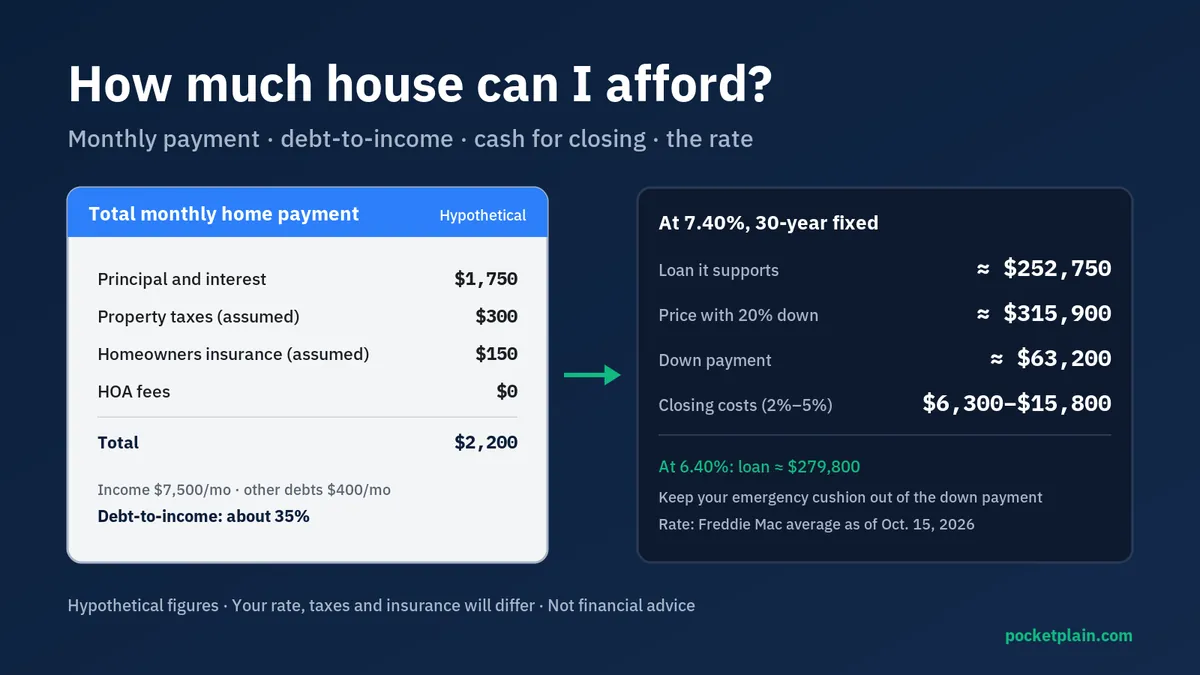
| Total monthly home payment you're comfortable with | $2,200 |
| Property taxes (assumed) | $300 a month |
| Homeowners insurance (assumed) | $150 a month |
| HOA fees | None |
| Left for principal and interest | $1,750 a month |
| Rate and term | 7.40%, 30-year fixed |
Loan size. At 7.40% for 30 years, $1,750 a month in principal and interest pays off a loan of about $252,750.
Home price. With 20% down, so no PMI on a conventional loan, that loan supports a price of about $315,900, with a down payment of about $63,200.
Cash at closing. Using the CFPB's 2% to 5% range, closing costs on that price would be about $6,300 to $15,800. Together with the down payment, that's roughly $69,500 to $79,000, and that money should come from what's left after your emergency cushion.
DTI check. $400 of existing debt plus the $2,200 home payment is $2,600 a month, or about 35% of gross income. Whether that works depends on the lender and the loan, and on whether $2,200 truly fits your budget.
Rate sensitivity. If the same household got 6.40% instead of 7.40%, the same $1,750 would carry a loan of about $279,800, roughly $27,000 more, or a price near $349,700 with 20% down. In practice, a higher price also means higher property taxes and insurance, so the real gain would be smaller.
The CFPB lists five factors that move the price you can afford: what you can pay monthly given your other debts, your down payment, the kind of loan, the interest rate and terms, and property costs such as taxes, insurance, utilities, maintenance and HOA fees. Change any one, and the answer changes.
Why the math feels harder now
The Federal Reserve's Survey of Consumer Finances, released Oct. 9, 2026, found that the median home owned by families was worth more than 4.5 times median family income in 2025, about unchanged from the previous high in 2022. It also estimated that the payment on a 30-year fixed mortgage covering 80% of the median home, plus property taxes of 1% of the home's value a year, took about 33% of monthly median family income in 2025, up from 26% in 2022 and an all-time high in the modern survey. The Fed attributes most of that increase to higher interest rates. That calculation leaves out insurance, maintenance and HOA fees.
If buying doesn't pencil out yet, compare it with renting using our rent vs. buy calculator, and keep your down payment savings somewhere safe and liquid, such as a high-yield savings account.
Before you talk to lenders
- Write down your own monthly limit for the total home payment before you get preapproved.
- Pull your credit reports and fix errors first.
- Keep your emergency cushion separate from the down payment.
- Ask more than one lender for a Loan Estimate and compare the rate, APR, PMI and closing costs line by line.
- Budget for maintenance, repairs and utilities on top of the payment.
Sources
- Consumer Financial Protection Bureau: "Figure out how much you want to spend," Buying a house guide (page last modified Feb. 18, 2026).
- Consumer Financial Protection Bureau: "What is a debt-to-income ratio?"
- Consumer Financial Protection Bureau: "What is private mortgage insurance?"
- Consumer Financial Protection Bureau: "What is an escrow or impound account?"
- Consumer Financial Protection Bureau: "Get your money situation in order," Buying a house guide.
- Consumer Financial Protection Bureau: "Understand the different kinds of loans available," Buying a house guide.
- Freddie Mac: Primary Mortgage Market Survey, as of Oct. 15, 2026.
- Federal Reserve Board: "Changes in U.S. Family Finances from 2022 to 2025: Evidence from the Survey of Consumer Finances," October 2026.
All sources were checked on Oct. 20, 2026. Loan and price figures in the example are our own calculations using the standard fixed-rate payment formula.
This content is for general education and is not financial advice. Mortgage rates, loan terms and requirements vary by lender and change often.