The Treasury Department and the IRS issued proposed regulations on Oct. 14, 2026, that rewrite key rules for the premium tax credit, the credit that lowers premiums for health plans bought through HealthCare.gov or a state marketplace. The agencies say the rules strengthen eligibility checks, close gaps in verification and restrict the credit to U.S. citizens, U.S. nationals and certain lawfully present noncitizens. IRS news release IR-2026-121
The proposal is not final, but much of what it describes is already law. It carries out changes Congress made in Public Law 119-21, enacted July 4, 2025, and commonly known as the One, Big, Beautiful Bill Act, and some of those changes already apply to 2026 coverage. Here is what changes and when, and what to check before open enrollment for 2027 begins on Nov. 1.
What the proposal covers, year by year
The notice of proposed rulemaking appeared in the Federal Register on Oct. 15, 2026 (REG-101576-26). Treasury and the IRS estimate it will affect about 15.6 million people enrolled in marketplace coverage, including 13.5 million who could potentially claim the credit. It also restates the basic income test: in general, household income must be at least 100% and no more than 400% of the federal poverty level for your family size. The temporary expansions under the American Rescue Plan Act and the Inflation Reduction Act, which had removed the 400% limit and lowered required contributions, applied only to tax years 2021 through 2025. Federal Register notice
| Change | Starts with | What it means |
|---|---|---|
| Income-based special enrollment | Plan years after Dec. 31, 2025 | A plan you join in a special enrollment period offered only because of your expected income, not a life event, doesn't qualify for the credit |
| Repayment cap removed | Tax year 2026 | You repay all excess advance credit when you file |
| Lawfully present, income under 100% of poverty level | Tax year 2026 | People in this group who can't get Medicaid because of immigration status no longer qualify |
| "Eligible alien" limit | Tax year 2027 | Only citizens, nationals and three groups of lawfully present noncitizens count toward the credit |
| Medicaid community engagement | Tax year 2027 (proposed rule) | Failing Medicaid's work or activity requirement doesn't open the door to the credit |
| Marketplace verification | Tax year 2028 | A month counts only after the marketplace verifies your eligibility |
The credit changes come from sections 71301 through 71305 of the law, and the Medicaid requirement from section 71119, each with its own effective date. Public Law 119-21 The notice says that while some of its proposed sections apply to tax years and plan years beginning on or after Oct. 15, 2026, the related provisions of the law already apply for 2026 and override conflicting parts of the current regulations.
No cap on paying back extra advance credit
When you enroll and ask for help, the marketplace estimates your credit from your expected household income, family and other coverage. You can have all, some or none of that estimate paid in advance to your insurer to lower your monthly premium. At tax time, you reconcile those advance payments with the credit you actually qualify for on Form 8962, using the Form 1095-A the marketplace sends you. You must file a return to do this even if you otherwise wouldn't have to, and the IRS warns that not filing may prevent future advance payments. IRS on claiming and reconciling the credit
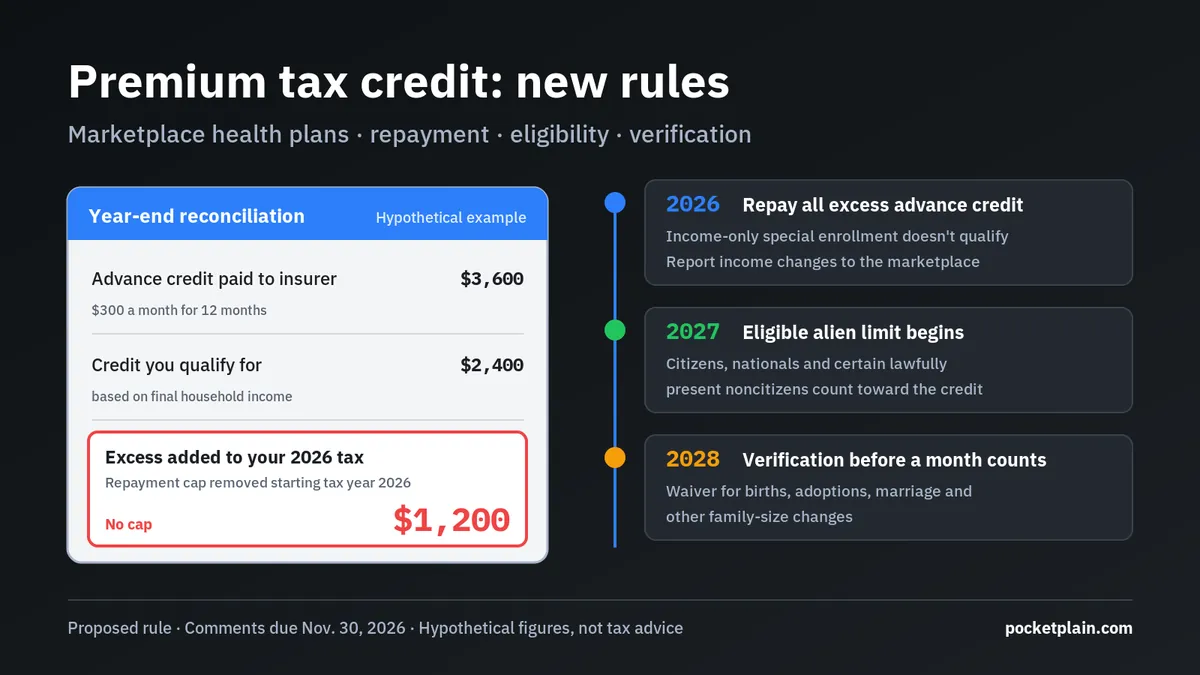
For tax years before 2026, if the advance payments were too high, the amount you had to add to your tax could be capped when household income was below 400% of the poverty level. The law removed that cap for tax years beginning after Dec. 31, 2025. The IRS page on reconciling the credit linked above still describes the old limit, which no longer applies starting with tax year 2026. For 2026 coverage, reconciled on the return you file in 2027, the full amount of excess advance credit increases your tax, the Federal Register notice says. Treasury and the IRS estimate that about 3.7 million returns will include a repayment of excess advance credit in 2028.
Hypothetical example, not based on a real case: if the marketplace paid $300 a month toward your premium, or $3,600 for the year, but your final income means you qualify for $200 a month, or $2,400, the $1,200 difference would be added to your 2026 tax bill, with no cap.
The best defense is keeping your estimate current. HealthCare.gov says to update your application as soon as possible when your income or household changes, because if your income estimate goes up or you lose a household member and you don't report it, you'll have to pay back the difference when you file. HealthCare.gov on reporting changes The IRS lists events that can push income up sharply, including lump-sum Social Security payments, lump-sum taxable distributions from an IRA or other retirement plan, and canceled debt, such as forgiven credit card debt. If you're planning a retirement withdrawal, our comparison of Roth vs. traditional IRAs explains which withdrawals are taxable.
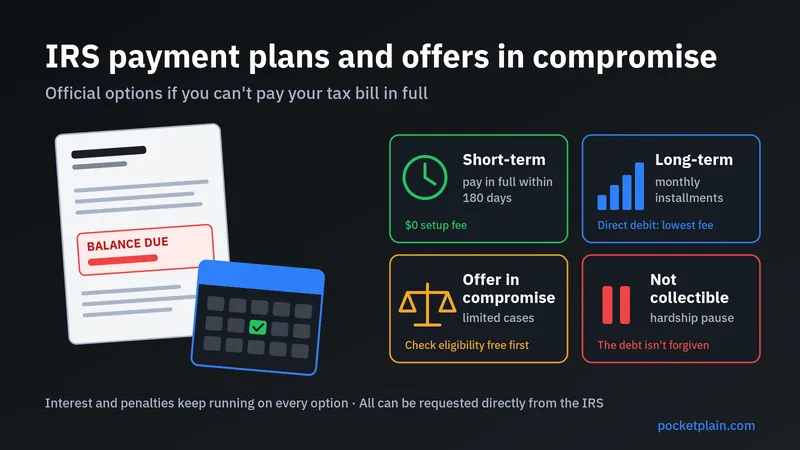
If your income is hard to predict, taking less of the credit in advance lowers the risk of a bill at tax time, though it raises your monthly premium; any credit you're owed comes back when you file. Setting money aside also helps, and our guide to how big an emergency fund should be can help you size that cushion. If you end up owing more than you can pay at once, see our guide to IRS payment plans and offers in compromise.
Who no longer qualifies
Two eligibility changes target immigration status. For tax years starting in 2026, the law dropped a rule that let lawfully present immigrants with household income below 100% of the poverty level claim the credit when immigration status kept them out of Medicaid.
Starting with tax year 2027, the credit covers only U.S. citizens, U.S. nationals and lawfully present noncitizens who count as "eligible aliens." Under the law, that means people who are, and are expected to remain for the whole enrollment period:
- Lawful permanent residents (green card holders)
- Cuban and Haitian entrants, as defined in federal law
- People who lawfully live in the U.S. under a Compact of Free Association
Other lawfully present noncitizens can still enroll in a marketplace plan, but their share of the premium would be left out of the credit calculation. In a household with mixed status, the proposal would require subtracting the portion of the premium and of the benchmark plan premium that belongs to those members. When advance credit is paid, the marketplace would report only the eligible portion on Form 1095-A. The notice's example: in a household with a citizen and a lawfully present member who isn't an eligible alien, each with a $500 monthly premium, Form 1095-A would show $500 instead of $1,000.
Special enrollment and Medicaid work requirements
For plan years beginning in 2026, coverage you enroll in during a special enrollment period that a marketplace offers based only on your expected income relative to the poverty line, and not tied to a qualifying life event, isn't treated as a qualified health plan for the credit. The proposal confirms that reading.
The proposal also addresses Medicaid's new community engagement requirement. Under the law, states must generally require people in Medicaid's adult group to show at least 80 hours a month of work, community service or a work program, or at least half-time enrollment in school, or meet certain income tests. States must start by Jan. 1, 2027, unless the Department of Health and Human Services grants a good faith exemption, which can't run past Dec. 31, 2028. If a marketplace finds you ineligible for Medicaid only because you didn't meet that requirement, the proposal would treat you as eligible for Medicaid, so those months wouldn't count for the premium tax credit. That treatment would end once you become ineligible for Medicaid for another reason, such as income rising above your state's limit.
Verification before a month counts, starting in 2028
Beginning with tax year 2028, the law says a month counts toward the credit only if the marketplace verifies your eligibility. Under the proposal, for everyone, that would mean your place of residence and that you're a U.S. citizen, a U.S. national or a lawfully present noncitizen. If advance credit is paid, the marketplace would also have to verify household income and family size, that you aren't eligible for other minimum essential coverage, such as Medicaid, and, for lawfully present noncitizens, eligible alien status. A plan also wouldn't count unless the marketplace offers a pre-enrollment check through which applicants can verify income and eligibility starting no later than Aug. 1 of the year before coverage.
The law lets Treasury waive verification for special enrollment periods based on a change in family size, and the proposal would apply that waiver to all of them, such as a birth, an adoption, a foster care placement, a marriage, or losing a dependent through death, divorce or legal separation. Treasury and the IRS estimate about 50,000 families with newborns will benefit. Separately, months of advance credit wouldn't count if the marketplace fails to check whether you reconciled advance payments for a prior year. That check exists because people who don't reconcile can be found ineligible for advance payments, one more reason to file Form 8962 every year. The Department of Health and Human Services is expected to propose matching rules for how marketplaces run these checks.
What to do before open enrollment
On HealthCare.gov, open enrollment for 2027 coverage starts Nov. 1. Enroll or change plans by Dec. 15 for coverage that starts Jan. 1, or by Jan. 15, when open enrollment ends, for coverage that starts Feb. 1. After that, you need a special enrollment period. HealthCare.gov dates and deadlines If your state runs its own marketplace, confirm its deadlines there.
Our checklist, based on the rules above:
- Update your income estimate for 2027. Include raises, side income and any planned retirement withdrawals.
- Report changes during the year. Higher income or a smaller household can mean less credit; reporting it lets the marketplace lower your advance payments.
- Decide how much credit to take in advance. Less in advance means a higher premium now but a smaller risk of owing later.
- Check each household member's status. Starting in 2027, a member who isn't a citizen, a national or an eligible alien won't count toward the credit.
- File Form 8962 with an accurate Form 1095-A. HealthCare.gov says not to file your taxes until you have an accurate 1095-A, and to keep it with your other tax records, like W-2s. HealthCare.gov on Form 1095-A Our IRS tax data security reminder covers how to protect those records.
If you're comparing plans for 2027, bronze and catastrophic marketplace plans can also work with a health savings account; see our guide to HSA limits and eligibility for 2026.
How to comment on the proposal
The rules could change before they're final. Comments are due Nov. 30, 2026, at regulations.gov under docket IRS-2026-1420 (cite REG-101576-26), and requests to speak at the telephone hearing scheduled for Dec. 8, 2026, at 10 a.m. ET, with an outline of topics, are due the same day. Requests to attend must arrive by 5 p.m. ET on Dec. 4, 2026. If no outlines arrive by Nov. 30, the hearing will be canceled. Whatever the final regulations say, the statutory changes take effect on the dates set in the law; the end of the repayment cap already applies for 2026.
Sources
- Internal Revenue Service: "Treasury and IRS move to protect health care benefits for eligible Americans," IR-2026-121, Oct. 14, 2026.
- Department of the Treasury, Internal Revenue Service: "Premium Tax Credit," notice of proposed rulemaking and notice of public hearing (REG-101576-26), 91 FR 65494, Federal Register, Oct. 15, 2026.
- Regulations.gov: docket IRS-2026-1420, "Premium Tax Credit (REG-101576-26)."
- U.S. Government Publishing Office (GovInfo): Public Law 119-21, sections 71301 through 71305, July 4, 2025.
- Internal Revenue Service: "Premium Tax Credit: Claiming the credit and reconciling advance credit payments."
- HealthCare.gov: "Reporting income & household changes after you're enrolled."
- HealthCare.gov: "A quick guide to the Health Insurance Marketplace: dates and deadlines."
- HealthCare.gov: "Use Form 1095-A when you file your taxes."
All sources were checked on Oct. 18, 2026.
This content is for general education and is not financial, tax or legal advice. Check your marketplace notices and IRS instructions for your situation, or talk to a tax professional.