Some credit cards come with travel protections, such as reimbursement for a canceled trip, lost bags, or damage to a rental car. That can be real value, but it is not the same thing as a travel insurance policy. Card benefits apply only under the conditions written in the card's guide to benefits, often only when you paid with that card, and they may leave out the medical and evacuation coverage that matters most on an international trip. The CDC puts it plainly: travelers should not consider credit card benefits a substitute for travel disruption, travel health, or medical evacuation insurance. CDC Yellow Book This comparison explains what card coverage usually looks like, where the gaps are, and when a standalone policy is worth pricing.
Compare travel insurance quotes
What credit card travel protections usually include
There is no single standard. The CDC says card travel benefits "vary widely in whom and what they cover." Official consumer guides describe these as the most common types:
- Trip cancellation and lost baggage. The NAIC, the organization of state insurance regulators, notes that some credit cards offer trip cancellation and lost baggage coverage, and suggests checking your card's policy to decide whether it is enough for you. NAIC: Should I Get Travel Insurance?
- Delays. The North Dakota Insurance Department says many cards, especially airline and hotel cards, provide coverage otherwise offered by travel insurance, and gives the example of a travel card covering flight delays only if the ticket was bought with that card. North Dakota Insurance Department
- Rental car damage. The FTC says many credit cards offer a collision damage waiver (CDW) when you use them to pay for a rental, and that some card companies include free rental protection. FTC: Renting a Car The NAIC says many cards include some level of collision and theft protection. NAIC: Auto Insurance
- Roadside help. The FTC notes you might have roadside coverage through your credit card when you use it to pay for the rental.
Not every card offers protection for free. An older North Carolina Department of Insurance consumer guide (PDF, file created in 2017) says some cards offer travel coverage "either for free or at an additional cost" and tells travelers to check with the card provider. NC Department of Insurance If you are still getting familiar with card accounts, fees, and agreements, start with how credit cards work.
The conditions that come with card coverage
Simply holding the card usually isn't enough. These are the conditions official sources point to most often:
- You usually have to pay with the card. "Simply having the credit card does not guarantee coverage," the North Dakota Insurance Department says; card companies typically require that the room or airfare was bought with the card. For rentals, Wisconsin's consumer protection agency says coverage may apply only if you pay for the rental with that card and/or decline the rental agency's loss damage waiver. Wisconsin DATCP
- You may have to decline the counter's waiver. To be eligible for a card's CDW, the FTC says, you'll need to decline the rental company's coverage.
- Some benefits require enrollment. And nearly all require a formal claim process with no guarantee of reimbursement, according to the CDC.
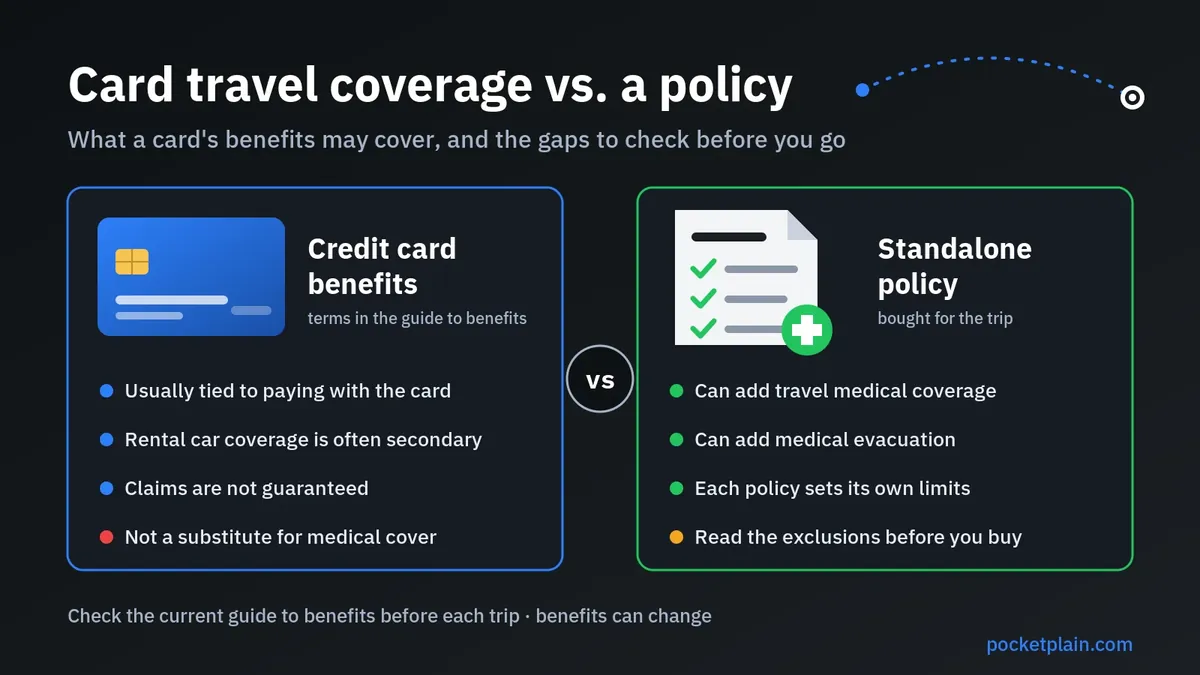
- Rental coverage is usually secondary. The NAIC says that in most cases card collision and theft benefits are secondary to your personal auto insurance or the rental company's insurance, so the card pays only after other coverage has been exhausted. The Texas Department of Insurance says the same: you'll have to use your auto policy first. Texas Department of Insurance: Rental cars
- The terms can change. The CFPB says you might not receive 45 days' advance notice of changes to the benefits you get from your credit card, because those changes generally aren't considered significant. CFPB A guide to benefits you read last year may not describe your card today.
What card benefits often leave out
The biggest gaps tend to be the expensive ones. Official sources describe card benefits mainly in terms of cancellations, baggage, delays, and rental cars, while the CDC lists travel health insurance and medical evacuation insurance as separate products that card benefits should not replace. If your guide to benefits doesn't name medical care or evacuation as covered, don't assume you have it.
That matters because your usual coverage may not travel with you:
- The U.S. government won't pay. The State Department says the U.S. government does not pay medical costs for U.S. citizens traveling abroad, and that Medicare and Medicaid do not pay for medical care outside the United States. It recommends buying travel health insurance before your trip. State Department: Travel Insurance
- Medicare rarely helps abroad. Medicare.gov says Medicare usually doesn't cover health care while you're traveling outside the U.S., with some exceptions, and that you pay all costs in most cases. Medicare.gov
- Trip cancellation isn't medical coverage. Even a dedicated trip cancellation policy usually does not pay for medical costs in other countries, according to the State Department.
- Evacuation is costly. The CDC says the total cost of a medical evacuation ranges from $25,000 for transport within North America to over $250,000 for more distant and remote locations.
Rental car coverage has limits too. A rental company's waiver won't pay for injuries to you or damage to your personal property, the FTC says. Wisconsin's consumer agency adds that some vehicles, such as some pickup trucks, SUVs, and pricey or exotic cars, might not be covered, and that whatever coverage you rely on (insurance, credit card, or CDW), there is usually no coverage if the damage occurs outside the United States or Canada. The State Department separately warns that your U.S. auto insurance might not cover you abroad.
Card coverage vs. a standalone policy, side by side
The table compares the two in general terms. Your card's guide to benefits and a policy's own wording are what actually decide a claim. For what each type of coverage in a travel insurance policy does, see travel insurance explained.
| Point of comparison | Credit card travel protections | Standalone travel insurance |
|---|---|---|
| How you get it | Comes with some cards, either free or at an additional cost. | Bought for a trip, from a travel company, an insurer, or a licensed agent. |
| Typical coverage | Trip cancellation, lost baggage, delays, rental car damage, depending on the card. | Can combine trip cancellation and interruption, travel medical, medical evacuation, baggage, and accidental death coverage. |
| Medical care and evacuation abroad | Not a substitute for travel health or medical evacuation insurance, per the CDC. | Available as travel medical and medical evacuation coverage, bundled or bought separately. |
| Main condition | Usually requires paying for the trip or rental with the card; some benefits require enrollment. | Each policy sets its own limits and lists the specific situations it will or won't cover. |
| Order of payment for rentals | Usually secondary to your personal auto insurance. | Depends on the policy; read its terms. |
| Cancel for any reason | Not described as a card benefit in the official sources we checked. | Usually sold as an add-on that costs more and typically reimburses only part of your trip cost. |
| Cost | No separate charge if included with your card; some cards charge for it. | Usually 5% to 10% of the total trip price, depending on season, destination, age, and other factors. |
| Can terms change? | Benefit changes may come without 45 days' notice. | The policy you buy sets the terms for that trip; some include a short "free look" period to cancel for a refund. |
When a standalone policy makes sense
Only you can decide whether you need travel insurance, the NAIC says, and its questions are a good starting point: Are you willing to lose money if you must cancel? Could you pay to rebook? Is severe weather likely? Are you or a loved one dealing with a health issue? With card benefits in the picture, a standalone policy is worth pricing in situations like these:
- You're leaving the country and your health plan won't follow you. The NAIC notes some people buy travel insurance because their health insurance doesn't cover them outside their home country. The State Department strongly recommends medical evacuation insurance when traveling to areas with higher risk or limited medical care.
- You're on Medicare. Medicare's coverage abroad is limited, and Medicare.gov says you may choose to buy a travel insurance policy for more coverage, while warning that travel insurance doesn't necessarily include health insurance. If you have a Medigap (Medicare Supplement Insurance) policy, Medicare.gov says Medigap policies "may cover emergency care when you travel outside the U.S." Medicare.gov: What Medigap covers
- You didn't book with the card. If the flights or hotel went on a different card or were paid another way, card coverage tied to that purchase may not apply.
- You have large nonrefundable costs. Compare your prepaid, nonrefundable total with the limits in your guide to benefits. The North Dakota department suggests checking the refund policies on prepaid expenses first, because few will refund you if you cancel at the last minute.
- You have a health condition or you're older. The CDC says conditions that required hospitalization or direct medical intervention in the 90 days before departure are often excluded, and that travelers over 75 should start researching specialized policies early.
- You want to be able to cancel for any reason. That flexibility comes from a CFAR add-on, which the NAIC says must typically be bought within a set period after booking.
Card coverage may be enough on a domestic trip where your health plan covers you, your bookings are mostly refundable, and you paid with a card whose current guide to benefits lists the protections you care about. Even then, the NAIC's advice applies: check what the card offers and decide whether it's enough for you.
If you decide you want a policy, the CDC notes that third-party websites let you compare available policies side by side; the CDC does not endorse any provider. One option is to compare travel insurance quotes with HelloSafe (affiliate link). Read the full policy wording before you buy; the Texas Department of Insurance says to make sure you know exactly what a plan covers. Texas Department of Insurance: Travel Watch for lookalike products, too: cruise and tour operators may sell cancellation waivers, which aren't insurance policies and aren't regulated.
Rental cars: card, auto policy, or the counter
Rental coverage is where card benefits are most often used, and where the order of coverage matters most.
- Start with your own auto policy. Wisconsin's consumer agency calls the insurance on your car your first line of protection for a rental, and says your policy needs collision and comprehensive coverage to protect a rental car. If you use your policy, you'll have to cover your deductible.
- Then check what the card adds. Card coverage is usually secondary, so it may pick up costs your auto policy doesn't.
- Decide on the counter's products last. The NAIC says a CDW, also called a loss damage waiver, can cost an extra $10 to $20 a day, and that you likely won't need it if you have comprehensive and collision coverage on your own car. Wisconsin notes a CDW is not insurance but a guarantee from the rental company, and that it may still make sense if your policy is liability-only or has a high deductible.
If you don't own a car, the NAIC suggests considering a non-owner auto policy, and says that if your credit card doesn't provide benefits, it might be wise to buy the liability insurance and CDW at the counter. Without a CDW or personal coverage, you're responsible for damage to the rental, sometimes its full value.
How to read your card's guide to benefits: a checklist
The CDC tells travelers to carefully review the card's guide to benefits to understand their coverage. Before a trip, look for answers to these questions:
- Which travel benefits are listed? Trip cancellation, interruption, delay, baggage, rental car damage, roadside help, medical care, evacuation. If one isn't listed, plan as if you don't have it.
- Do I need to enroll or activate anything? Some benefits require it.
- What must be paid with the card? The trip, the airfare or room, or the full rental?
- Who is covered? Benefits vary in whom they cover, so check family members and travel companions.
- Which reasons count? The North Dakota department tells travel insurance buyers to review the list of covered reasons for canceling a trip; apply the same test to your card's trip cancellation and interruption terms.
- What are the limits? Compare the maximum payouts with your prepaid, nonrefundable costs.
- Is rental coverage primary or secondary? Usually secondary.
- Which vehicles and places are excluded? Some trucks, SUVs, and exotic cars, and damage outside the U.S. or Canada, may not be covered.
- How do claims work? Nearly all card benefits require a formal claim, with no guarantee of reimbursement, so keep receipts and documents.
- Is this the current version? Changes to card benefits may come without 45 days' notice. For rentals, Wisconsin suggests printing the coverage terms from the card's website and bringing them along.
If something isn't clear, ask. The NAIC recommends calling your credit card company about rental benefits, and Wisconsin suggests going over all coverages with a card customer service representative.
Keep a cash backstop for the bills insurance won't cover first
Even with coverage, you may pay first and get reimbursed later. The CDC says medical care abroad usually requires a cash or credit card payment at the point of service, even with a travel health policy. The FTC says most rental companies also place a hold on your card for more than the agreed-on rental cost, which can get the card declined for other purchases if you're near your credit limit.
Putting a large bill on a card while you wait for a claim can be practical, but a balance you carry accrues interest under your card's terms; our explainer on credit card APR covers how that works. An emergency fund is the backstop that neither card benefits nor insurance replaces, and our guide to how much to keep in an emergency fund can help you size one. Keeping travel money in a high-yield savings account is one way to have cash ready.
Compare travel insurance quotes
FAQ
Does my credit card's travel insurance cover medical bills abroad? Don't assume so. Check whether your guide to benefits lists medical care or evacuation. The CDC says card benefits are not a substitute for travel health or medical evacuation insurance.
Do I have to pay for the trip with the card to be covered? Usually. The North Dakota Insurance Department says card companies typically require that the room or airfare was bought with the card, and that simply having the card does not guarantee coverage.
What does "secondary coverage" mean for a rental car? The card pays only after other coverage, such as your personal auto insurance or the rental company's insurance, has been used. The NAIC says this is how card benefits work in most cases.
Should I buy the rental counter's collision damage waiver if my card offers one? To use a card's CDW, you generally need to decline the rental company's coverage. Whether to skip it depends on your own auto policy, your deductible, the car, and where you're driving; check the card's terms before you reach the counter.
Can my card issuer change a travel benefit? It can happen. The CFPB says the card company has the right to change the terms of your credit card agreement, and that you might not get 45 days' notice of changes to the benefits you get from your card, such as points or cash rewards, because those changes generally aren't considered significant. Check the current guide to benefits before each trip.
Who can help if a travel insurance claim is denied? Travel insurance is regulated by the states. The NAIC says your state department of insurance can help with travel insurance questions.
Sources and how this comparison was made
- Federal agencies: CDC Yellow Book 2026, travel insurance chapter (Apr. 23, 2025); State Department: Travel Insurance (last updated Aug. 11, 2025); FTC: Renting a Car; CFPB: Can my credit card company change the terms of my account? (last reviewed Jan. 22, 2024); Medicare.gov: Travel outside the U.S.; Medicare.gov: What Medigap covers
- State insurance regulators (NAIC): Should I Get Travel Insurance? (June 16, 2026) and Auto Insurance, rental car section.
- State agencies: Texas Department of Insurance on rental car insurance (last updated July 30, 2026) and travel insurance (last updated May 28, 2026); North Dakota Insurance Department; North Carolina Department of Insurance consumer guide (PDF, undated; file created in 2017); Wisconsin DATCP on car rentals and collision damage waivers.
All sources were checked on Oct. 17, 2026. This comparison describes credit card travel protections and travel insurance in general terms. It does not review, rank, or name any card or insurer, and it quotes no card-specific limits; benefits, prices, and rules vary by card, policy, and state. The HelloSafe link is an affiliate link; it does not change what this comparison says.
This content is for general education and is not financial advice. Read your card's guide to benefits and any policy documents, and ask the card's benefit administrator or the insurer about your situation before you rely on coverage.