Paying only the minimum on a credit card keeps the account current, but it can stretch a modest balance across many years. Federal rules already require your statement to show that math. This guide explains the warning box, runs one hypothetical $3,000 balance through three payment rules side by side, and walks through a general framework and the debt relief pitches the CFPB warns about.
Pocket Plain is owned and edited by Thiago Costa, who also runs the Steady Wallet YouTube channel. This guide is the written companion to Steady Wallet's video on credit card minimum payments. Pocket Plain may earn money from ads on this page; this article contains no affiliate links.
The box on your statement most people skip
Most people look at two numbers on a card statement: the minimum payment due and the due date. Near them sits a box that answers a bigger question: how long the balance will last if you keep paying only that minimum.
The CFPB explains that card issuers are required to let you know how long it will take to pay off your current balance if you make no further charges and pay only the minimum amount due each month. They are also required to show, based on the balance as of the statement date, how much you would need to pay each month to pay off that balance in 36 months. CFPB on the three-year box
That box is personal in a way no article can be: it uses your balance, your APR, and your issuer's minimum payment formula. If you only take one thing from this guide, make it this: find the box on your latest statement and read it.
What Regulation Z requires on every statement
The requirement comes from Regulation Z, the federal rule that implements the Truth in Lending Act, at 12 CFR 1026.7(b)(12). For most credit card accounts, the periodic statement must include a statement with a bold heading that reads: Regulation Z §1026.7(b)(12)
"Minimum Payment Warning: If you make only the minimum payment each period, you will pay more in interest and it will take you longer to pay off your balance;"
Here is what the warning box contains under the rule:
| What the box shows | What it means |
|---|---|
| Minimum Payment Warning | The required bold-heading statement quoted above. Reg Z §1026.7(b)(12) |
| Minimum payment repayment estimate | How long it would take to pay off the statement balance making only minimum payments, calculated as described in Appendix M1. Reg Z §1026.7(b)(12) |
| Total cost on minimum payments | The estimated total you would pay, assuming only minimum payments and nothing else added to the balance. Reg Z §1026.7(b)(12) |
| 36-month payment, cost, and savings | The estimated monthly payment to repay the balance in 36 months, the total cost at that pace, and the savings versus the minimum. Issuers don't have to show these if the minimum-payment estimate is 3 years or less after rounding. Reg Z §1026.7(b)(12) |
| Credit counseling phone number | A toll-free number where you can get information about credit counseling services from the issuer. Reg Z §1026.7(b)(12) |
The rule also covers a harsher case. If paying only the minimum would never reduce the balance (the payment doesn't cover the interest charged each month), the statement must instead say that you will never pay off the balance by making only the minimum payment. Reg Z §1026.7(b)(12)
The 36-month figure follows Appendix M1, which tells issuers to calculate the monthly amount that would pay off the outstanding balance within 36 months, assuming you pay the same amount each month. Regulation Z Appendix M1
Three things the CFPB makes clear about these estimates: CFPB on the three-year box
- They are based on your current balance and don't account for future purchases. New charges change the math.
- You don't have to pay more than the minimum shown on your statement.
- The more you pay each month, the less interest you pay over time; paying only the minimum could take years.
For how statements, billing cycles, and grace periods fit together, see how credit cards work.
How large U.S. card balances are right now
You are not alone if a card balance carries over from month to month. The Federal Reserve Bank of New York's Household Debt and Credit Report for the second quarter of 2026 put the national picture this way: NY Fed, Q2 2026
| Measure (as of Q2 2026) | Figure |
|---|---|
| U.S. credit card balances | $1.26 trillion, up $21 billion from the prior quarter ($1.263 trillion in the report's table) NY Fed, Q2 2026 |
| Share of credit card balances newly becoming 90+ days late (annualized) | 6.97%, compared with 6.93% in Q2 2025 NY Fed, Q2 2026 |
The point isn't alarm. Lots of balances are revolving at high rates, and that's the situation the warning box is meant to put a price on.
Three scenarios for the same $3,000
To see why the payment rule matters so much, we ran one balance three ways. The rate comes from the Federal Reserve's October 7, 2026 G.19 release: for August 2026, the average rate at commercial banks on credit card accounts assessed interest was 22.36% (the average stated APR across all accounts was 21.19%). These figures are preliminary and averages; your rate depends on your cardholder agreement. Federal Reserve G.19, Oct. 7, 2026 For how APR turns into interest, see how credit card APR works.
Hypothetical example. Not a real account or a real card's terms. Assumptions:
- Starting balance: $3,000
- APR: 22.36%, fixed for the whole period; monthly interest = APR ÷ 12
- Minimum payment (scenario A): 1% of the balance plus that month's interest, with a $35 floor. This is a common-style formula used only for illustration; minimum formulas vary by issuer.
- No new purchases, no fees, every payment on time
| Scenario | Monthly payment | Months to pay off | Total interest | Total paid |
|---|---|---|---|---|
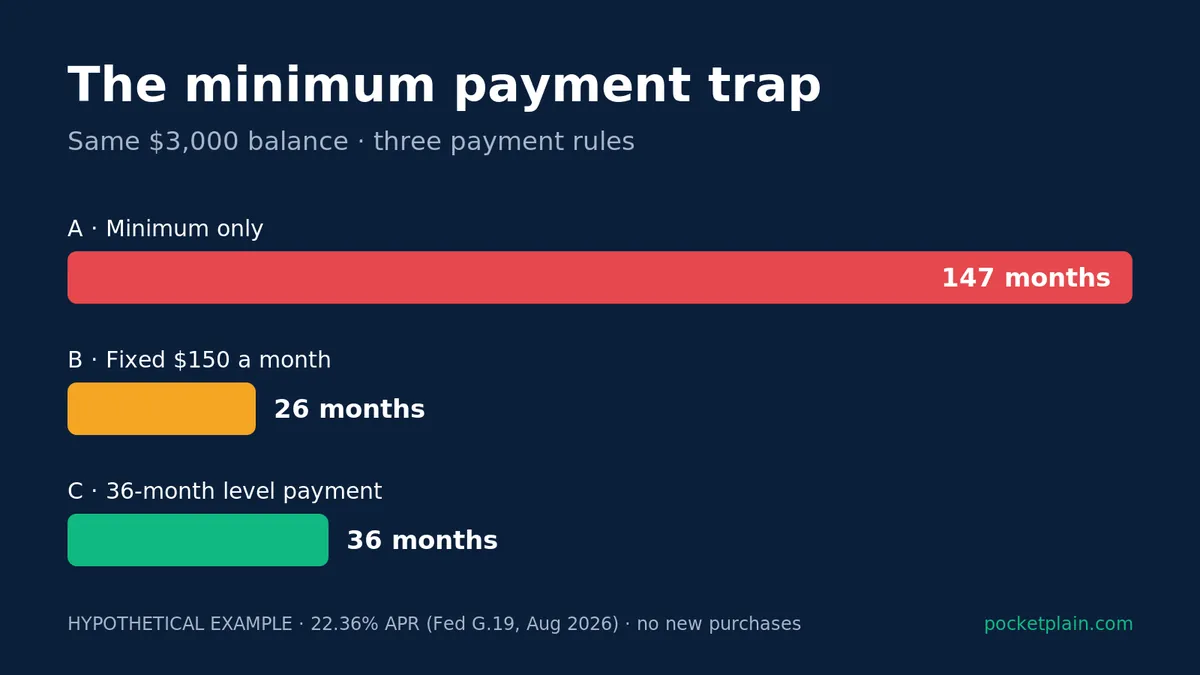
| A. Minimum only | Starts at about $85.90, then shrinks with the balance (never below $35 until the final payment) | 147 (about 12 years 3 months) | about $4,084 | about $7,084 |
| B. Fixed $150 | $150 (smaller final payment) | 26 | about $789 | about $3,789 |
| C. 36-month payoff | $115.13 | 36 | about $1,145 | about $4,145 |
Our own calculation (Oct. 17, 2026), month-by-month, using the assumptions above. Scenario C uses a standard level-payment amortization formula, in line with the Appendix M1 idea of paying the same amount each month for 36 months. Real statements may differ slightly because issuers compute interest daily and use their own minimum formulas.
Picture the three as timelines that start at the same $3,000:
- A (minimum only): 147 months. In month one, about $55.90 of the $85.90 payment is interest and only $30 reduces the balance. As the balance falls, the minimum falls with it, so the payoff keeps slowing down.
- B (fixed $150): 26 months. The payment doesn't shrink, so more of each dollar goes to principal as the balance drops.
- C (36-month level payment): 36 months, the same kind of figure the warning box shows when the rule requires it.
In this hypothetical, a fixed $150 payment costs roughly $3,296 less in interest than the minimum-only path, and the 36-month payment costs roughly $2,940 less. The B payment isn't a recommendation; it's an illustration that a payment rule that doesn't shrink with the balance changes both the timeline and the total.
Your issuer's minimum formula may differ from ours. The warning box on your own statement is the estimate that applies to you.
A four-step framework (not personal advice)
This is a general way to organize the problem, not a prescription. Your income, other debts, and savings all matter, and outcomes vary.
- List every card balance. From your statements, write down each card's balance, APR, minimum due, due date, and what its warning box says.
- Protect the minimums if you can. Falling behind usually makes debt more expensive. If you can't pay, the CFPB says to act right away and contact your card company immediately. CFPB: can't pay your card bills
- Ask your issuer what options exist. The CFPB says many card companies are willing to work with you to change your payment if you're facing a financial emergency. It suggests clearly explaining why you can't pay the minimum, how much you can afford, when you could restart normal payments, and what new payment amount you're requesting and for how long. CFPB: can't pay your card bills You can also ask about a lower APR. Nothing is guaranteed; if you're offered new terms, get them in writing before deciding.
- When your budget allows, set a fixed amount above the minimum. Replace "whatever is left over" with a dollar amount you can repeat every month. As scenarios B and C show, a steady payment doesn't shrink as the balance does, which is what moves the timeline. If you have more than one card, see debt snowball versus avalanche for two common ways to decide where extra dollars go.
Some people look at moving a balance to a lower promotional rate. If you consider it, read the transfer fee, the length of the promotion, and the rate that applies afterward in the terms yourself; those can reduce or erase the benefit. We don't recommend any card or product.
Debt relief pitches vs. nonprofit counseling
If the numbers feel unmanageable, you may see ads promising to cut what you owe. The CFPB describes debt relief or settlement companies as companies that say they can renegotiate, settle, or otherwise change the terms of your debt, and says dealing with them can be risky. CFPB on debt relief programs
Red flags the CFPB describes:
- Fees before results. Debt settlement companies often charge expensive fees, and a debt settlement company is not allowed to collect fees before settling or resolving your debt. CFPB on debt relief programs CFPB: can't pay your card bills
- Being told to stop paying. These companies typically encourage you to stop paying your card bills. If you do, you will usually incur late fees, penalty interest, and other charges, and creditors will likely step up collection efforts. CFPB on debt relief programs
- Lawsuits and credit damage. Working with a debt settlement company may lead to a creditor filing a collection lawsuit, and it can hurt your credit scores. Unless the company settles all or most of your debts, penalties and fees on unsettled debts may wipe out any savings. CFPB on debt relief programs
What the CFPB points to instead: consider all your options, including working with a nonprofit credit counselor and negotiating directly with the creditor yourself. CFPB on debt relief programs Credit counseling organizations are usually nonprofits; they can advise on money and debts, help you develop a budget, and organize a debt management plan. CFPB on credit counseling Before you sign up, the CFPB suggests asking whether you'll be charged, how much, and what services will be provided. CFPB: can't pay your card bills Your statement's warning box already lists a toll-free number for credit counseling information. Reg Z §1026.7(b)(12)
FAQ
Do I have to pay the 36-month amount on my statement? No. The CFPB says you don't have to pay more than the minimum shown on your statement; the 36-month figure shows what it would take to clear the current balance in three years. CFPB on the three-year box
If I pay the 36-month amount and keep using the card, will I be done in three years? Not necessarily. The estimate is based on the current balance and doesn't take future purchases into account. CFPB on the three-year box
Why doesn't my statement show a 36-month payment? Under Regulation Z, issuers don't have to show the 36-month disclosures if the minimum-payment estimate, after rounding, is 3 years or less, or if the 36-month payment would be less than the required minimum payment. Some billing cycles are exempt from the warning entirely, for example after you paid the balance in full two cycles in a row. Reg Z §1026.7(b)(12)(i)(F)(2) and (b)(12)(v)
Sources and how this guide was made
- Government (CFPB): Regulation Z §1026.7(b)(12) and Appendix M1; Ask CFPB answers on the three-year box, what to do if you can't pay, debt relief programs, and credit counseling; the CFPB credit cards hub.
- Federal Reserve: G.19 Consumer Credit, Oct. 7, 2026 release (August 2026 rates, preliminary); NY Fed Household Debt and Credit Report, Q2 2026.
- Hypothetical: the three-scenario table is our own month-by-month calculation using the assumptions stated above. It is not a real account and doesn't describe any issuer's terms.
All sources were checked on Oct. 17, 2026. Averages like the G.19 rate update over time.
This article is educational information, not financial advice. Check your own cardholder agreement and statements for the terms that apply to you, and consider speaking with a qualified professional about your situation.