A typical credit card is a revolving credit account: you borrow within a credit limit, repay the issuer, and can borrow again as credit becomes available. Purchases create debt you must repay under the account's terms. CFPB credit-card definition
Understand your credit limit
Your credit limit is the amount the issuer allows you to charge on the card. It describes borrowing capacity, not income or money in a bank account. A purchase within that limit still needs to fit your household budget.
With a credit card, you use borrowed money. A debit card generally spends money already in your bank or credit union account, while a prepaid card generally spends money loaded onto the card. Similar logos do not make these payment methods work the same way. CFPB card comparison
Read the billing cycle and statement
A billing cycle is the period covered by a statement. The statement records activity such as purchases, payments, fees, and interest. At the end of the cycle, it shows what you owe and the payment required. CFPB billing terminology
| Statement item | What it means |
|---|---|
| Billing period | The dates covered by that statement |
| Statement balance | The amount owed at the end of that billing period |
| Minimum payment | The amount you must pay by the due date to meet that bill's payment requirement |
| Payment due date | The deadline for the issuer to receive the required payment |
Review the statement even if you use automatic payments. Check the transactions, fees, interest, payment amount, and due date against your records.
Issuers must establish procedures to ensure bills are mailed or delivered at least 21 days before payment is due. That statement-timing requirement applies separately from whether the card offers a purchase grace period. CFPB statement timing and grace periods
How a purchase grace period works
A grace period runs between the end of a billing cycle and the payment due date. Issuers are not required to offer one, although most cards provide a grace period for purchases.
If your card has a purchase grace period and you are not carrying a balance, paying the statement balance in full by the due date can avoid interest on new purchases. Paying only part of that balance can mean losing the grace period. Interest can then apply to the unpaid portion and to purchases in the new cycle from the dates they are made.
Grace periods typically apply only to purchases. Cash advances and checks supplied by an issuer generally begin accruing interest on the transaction date. Check which transactions your account's grace period covers. CFPB grace-period explanation
How APR and interest work
APR stands for annual percentage rate. For credit cards, it generally expresses the interest rate as a yearly rate. Some issuers compound interest daily by adding interest to the balance used for later interest calculations. CFPB interest-rate and daily-rate definitions
Many issuers calculate interest daily using an average daily balance. Payments and new charges affect the balances used in the calculation. The daily periodic rate is the interest rate applied for a day; an annual rate does not mean interest is charged only annually.
When interest accrues daily and no grace period applies, paying some or all of a balance sooner can reduce interest. The issuer's agreement explains the method used for your account. CFPB interest calculation
Why a card can have different costs
A card can apply different APRs to purchases, cash advances, or other transactions. Your statement must show each category with a different APR and the balance in that category. Check the rate attached to the transaction you are making. CFPB APR categories
Fees also affect the cost. Depending on the agreement, an annual fee or a balance-transfer fee may apply. A promotional APR can expire and be replaced by a different rate. Read the fee terms and the promotion's end date alongside the APR. CFPB guide to agreement terms
Minimum payments and the payoff disclosure
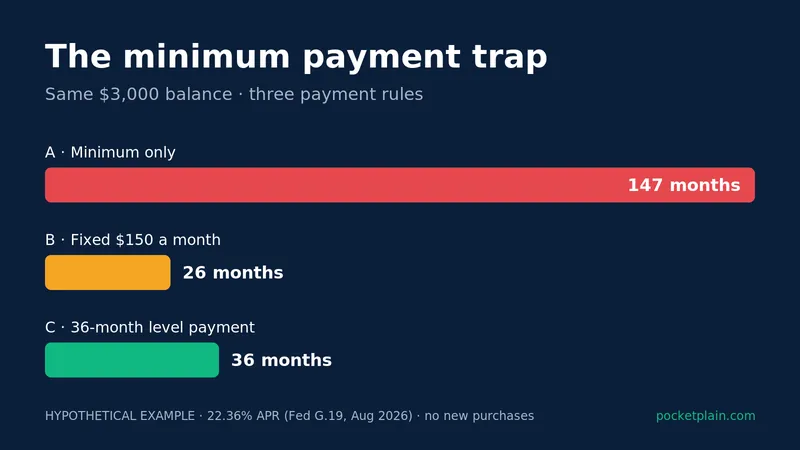
The minimum payment is the amount required for that bill. Paying only the minimum can leave debt accruing interest and can stretch repayment over years. Paying more can reduce interest costs and shorten repayment.
Paying the full statement balance serves a different purpose: when the purchase grace-period conditions are met, it can avoid purchase interest. Making the minimum payment on time does not by itself establish that those conditions are met.
The 36-month payoff disclosure shows the estimated monthly payment needed to repay the current statement balance over that period. The statement also estimates how long repayment would take with minimum payments alone. These calculations assume no further charges.
The payoff estimate does not raise your required minimum payment. Adding purchases changes what you owe, so following the displayed amount while continuing to spend does not guarantee repayment within the stated period. CFPB payoff-box explanation
Late payments and billing rights
Late payments can trigger late fees. The permitted amounts are regulated and can change, so check the agreement rather than assuming a universal fee. CFPB late-fee explanation
A payment generally needs to be received by the due date, not simply mailed that day. Processing times and the issuer's cutoff for online payments matter. If you are charged a late fee, you can ask the issuer whether it will waive it. CFPB payment-timing guidance
If a statement contains a charge you dispute, contact the issuer promptly. To protect your billing-error rights, the CFPB says you must also send written notice within 60 calendar days after the charge appeared on your statement. Keep copies and records of follow-up calls. The agreement explains the applicable dispute procedures. CFPB billing-dispute instructions
How card use affects your credit
Credit card companies can supply account information to credit reporting companies. Reports may show credit limits, balances, and payment history. CFPB credit-report explanation
Payment history and how much available credit you use can affect credit scores. Carrying a balance is unnecessary for building a good score; paying interest is not a requirement for establishing credit history. CFPB credit-building guidance
Our guide to credit reports and credit scores explains the difference between the underlying record and a score. To review individual accounts and investigate errors, see how to read your credit report.
Fit repayment into your budget
Include card purchases in your spending plan when you make them, and account for the cash needed to pay the bill. Available credit does not establish what you can afford. A budget and emergency-fund plan can help connect upcoming payments with available cash.
Reminders or automatic payments can support timely repayment, but still check the payment setting and the account used to fund it. If you already carry balances, our debt snowball versus avalanche guide explains ways to direct extra payments.
If you cannot afford the minimum, contact the issuer promptly. Explain what you can pay and ask about possible payment arrangements. CFPB guidance when you cannot pay
This article is educational information, not personal financial or tax advice.