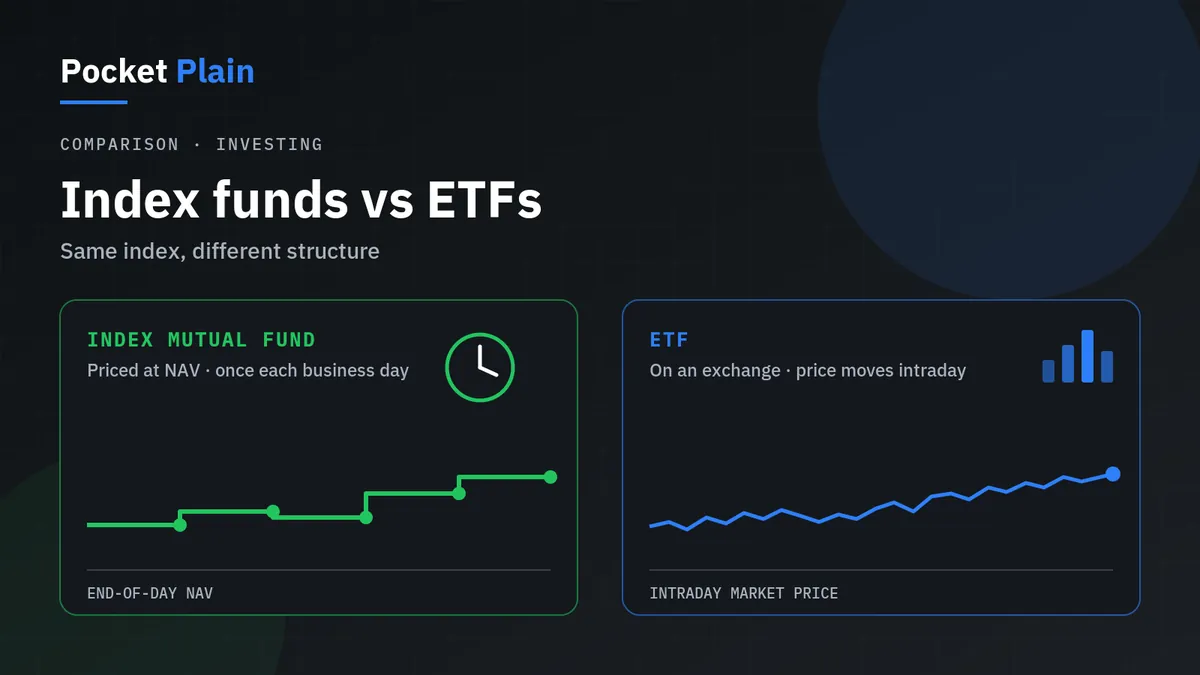
"Index fund vs ETF" sounds like a choice between opposites, but it isn't. An index fund is a mutual fund or an exchange-traded fund (ETF) that seeks to track the returns of a market index, so an ETF can itself be an index fund. SEC index fund bulletin
The real comparison for most readers is an index mutual fund versus an index ETF. Both pool money from many investors, but they are structured differently, which changes how you buy and sell shares, the price you get, the fees you pay and how taxes can work in a taxable account. SEC mutual fund and ETF bulletin
What an index fund does
A market index measures the performance of a "basket" of securities, such as stocks or bonds. You cannot invest directly in an index; an index fund gives you an indirect way to follow one. SEC index fund bulletin
Some index funds buy every security in the index, while others hold only a sample. Index funds have generally followed a passive style, trading less often than an actively managed fund that tries to beat a market. SEC index fund bulletin
Because the manager is not picking securities, an index fund may cost less to run. The SEC adds that not all index funds have lower costs than actively managed funds, so check the actual cost of each fund. SEC index fund bulletin
What makes an ETF different
ETFs are registered investment companies, like mutual funds, and can be index-based or actively managed. Unlike mutual funds, ETFs do not sell shares directly to, or redeem shares directly from, retail investors. Their shares trade throughout the day on national stock exchanges at market prices, and most ETFs post their holdings on their websites daily. SEC ETF bulletin
You can't always tell a fund's structure from its name. Some ETFs do not use "ETF" in their name, and some exchange-traded products that are not registered under the Investment Company Act of 1940 still use it. The investment strategy section of the prospectus tells you what the fund is. SEC mutual fund and ETF bulletin
Index mutual fund vs ETF, side by side
| Feature | Index mutual fund | Index ETF |
|---|---|---|
| Where you buy and sell | From the fund itself or through an intermediary such as a broker; you can sell shares back to the fund | Only in market transactions on an exchange; you need a brokerage account to buy, sell and hold shares |
| Price you get | NAV per share, plus or minus fees, typically calculated at the end of each business day | Market price during the trading day, which may be above (premium) or below (discount) NAV |
| When you know the price | Not until the end of the business day | Real-time or near real-time while the market is open |
| Fees charged directly to you | Some mutual funds charge shareholder fees, such as sales loads, redemption, exchange or account fees | ETFs generally do not charge fees directly to investors for buying or selling shares, but you may pay brokerage commissions and bid-ask spreads |
| 12b-1 fees | Typically apply to mutual funds | Typically do not apply to ETFs |
| Taxes in a taxable account | Generally owe tax on capital gains distributions received | May also owe tax on distributions, but many ETFs typically have fewer of them |
| Taxes in a 401(k) or IRA | No tax difference between the two | No tax difference between the two |
Sources for the table: SEC mutual fund and ETF bulletin, SEC fees and expenses bulletin and SEC ETF bulletin.
What the two have in common
Both are investment companies that file registration statements with the SEC, and both disclose key information in a prospectus you can get free from the SEC's EDGAR database or the fund. Both are typically managed by SEC-registered investment advisers. SEC mutual fund and ETF bulletin
Both can help you diversify, though some are less diversified than others because they hold fewer investments, and some ETFs even track a single stock. Both are liquid, both can have relatively low minimum investments, and both charge fees and expenses regardless of how the fund performs. SEC mutual fund and ETF bulletin
Neither is a bank deposit. The FDIC lists mutual funds and stock and bond investments among products it does not insure, even when bought from an insured bank, and notes they may lose value. FDIC uninsured products Our guide to FDIC deposit insurance explains what is covered.
The FDIC also describes SIPC, a non-government entity that replaces missing stocks and other securities in customer accounts held by its members, up to $500,000, including up to $250,000 in cash, if a member brokerage fails. SIPC does not protect you against a loss in an investment's value. FDIC uninsured products
How costs compare
Both types pay operating expenses out of fund assets. The total, expressed as a percentage of the fund's average net assets, is the expense ratio shown in the prospectus fee table. SEC fees and expenses bulletin
The SEC says ETFs have tended to be less expensive to operate than mutual funds that invest in a similar way, partly because of distribution differences and often lower transaction costs. SEC ETF bulletin That is a tendency, not a rule, so compare the specific funds.
Mutual fund costs to look for:
- 12b-1 fees cover distribution and sometimes shareholder services; they typically apply to mutual funds but not to ETFs. SEC fees and expenses bulletin
- Sales loads can be front-end or back-end. In the SEC's own example, a 5% front-end load on a $10,000 purchase takes $500, leaving $9,500 to invest. SEC fees and expenses bulletin
- "No-load" is not "no fees." A no-load fund may still charge purchase, redemption, exchange or account fees. SEC fees and expenses bulletin
- Share classes of the same fund can carry different loads and operating expenses, which can lead to different returns. SEC fees and expenses bulletin
ETF costs that the prospectus fee table does not show:
- Brokerage commissions. A flat commission costs a larger percentage of a smaller trade. SEC fees and expenses bulletin
- Premiums and discounts to NAV. You may pay more or receive less than the NAV per share. SEC fees and expenses bulletin
- The bid-ask spread. In the SEC's example, an ETF quoted at $59.50/$60 has a 50-cent spread; buying 200 shares at $60 and selling them right away at $59.50 would lose $100. More liquid, heavily traded ETFs typically have tighter spreads. SEC ETF bulletin
Small ongoing fees add up. In the SEC's hypothetical, $100,000 growing 4% a year for 20 years ends at about $208,000 with a 0.25% annual fee, $198,000 with 0.50% and $179,000 with 1.00%. SEC fee impact bulletin To test your own assumptions, try different net return rates in our compound interest calculator.
How taxes can differ
In a taxable account, such as a regular brokerage account, mutual fund investors generally pay taxes on capital gains distributions they receive. ETF investors may owe tax on distributions too, but because many ETFs buy and sell portfolio securities through in-kind exchanges rather than for cash, they typically have fewer capital gains distributions and lower taxes. SEC mutual fund and ETF bulletin
Inside a tax-advantaged account, such as a 401(k) or IRA, the SEC says there is no tax difference between an ETF and a mutual fund. SEC mutual fund and ETF bulletin For the account side of that decision, see our comparison of a Roth vs traditional IRA and the 2026 401(k) and IRA contribution limits.
How buying, selling and pricing work
With a mutual fund, you can place an order at any point during the business day, but you will not know the exact price per share until the end of that day. SEC mutual fund and ETF bulletin
With an ETF, you trade at the prevailing market price while the exchange is open. Large broker-dealers called authorized participants create and redeem ETF shares directly with the fund, usually in large blocks; their arbitrage generally keeps the market price close to the ETF's NAV. SEC ETF bulletin The price can still vary significantly from NAV, and the SEC notes the risk that a trading market may not develop at all. SEC mutual fund and ETF bulletin, SEC ETF bulletin
Which may suit which situation
This is general education, not a recommendation. These scenarios show where the structural differences tend to matter:
- Investing through a workplace 401(k). Your options are the ones the plan offers. Inside the plan the SEC sees no tax difference between the two, and plan administration expenses may be passed on to you on top of fund expenses. SEC mutual fund and ETF bulletin, SEC fee impact bulletin
- Investing in a taxable brokerage account. The ETF structure's typically lower capital gains distributions can matter here. SEC mutual fund and ETF bulletin
- Making small, frequent purchases. Check whether your broker charges a commission per ETF trade and whether a mutual fund has a minimum investment or an account fee. SEC fees and expenses bulletin, SEC mutual fund and ETF bulletin
- Wanting to know the exact price when you trade. An ETF trades at a visible market price during the day; a mutual fund order is priced at the next calculated NAV, typically at the end of the business day. SEC mutual fund and ETF bulletin
- Money you may need soon. Funds can lose value and are not FDIC-insured, even when bought through a bank. FDIC uninsured products If the money is your safety cushion, compare that risk with the insured options covered in emergency fund planning and how high-yield savings accounts work.
Checklist before you choose a fund
- Read the prospectus and latest shareholder report. The prospectus describes the fund's objective, strategies, risks, costs and historical performance. SEC ETF bulletin, SEC index fund bulletin
- Compare the fee table line by line, including the share class you would actually buy. SEC fees and expenses bulletin
- For an ETF, check its website for NAV, closing price, premiums or discounts, holdings and median bid-ask spread. SEC ETF bulletin
- Know which index it tracks and how the index is built. SEC index fund bulletin
- Understand index fund risks. An index fund carries the same general risks as the securities in its index. It may not track the index perfectly, may underperform it after fees, trading costs and tracking error, and has less flexibility to react to price declines. SEC index fund bulletin
How we compared
We compared the two structures using investor bulletins the SEC publishes on Investor.gov and the FDIC's guide to uninsured products, all read on Oct. 16, 2026. The SEC bulletins are dated Aug. 6, 2018 (index funds), Feb. 23, 2023 (ETFs), April 29, 2025 (mutual funds and ETFs) and July 23, 2025 (fees); the FDIC page was last updated May 12, 2026.
We did not rank or review specific funds, providers or brokers, and we used no performance data or current fee quotes. Dollar figures are the SEC's own illustrative examples. This comparison covers ETFs registered under the Investment Company Act of 1940, not exchange-traded notes or commodity products, nor leveraged or inverse ETFs, which typically seek their stated performance objectives on a daily basis and can perform very differently over longer periods (SEC leveraged and inverse ETF bulletin), and traditional market-index funds rather than funds built on custom indexes. Tax points are general federal descriptions, not tax advice.
This article is educational information, not financial advice. Check each fund's prospectus and your account terms for the details that apply to you.