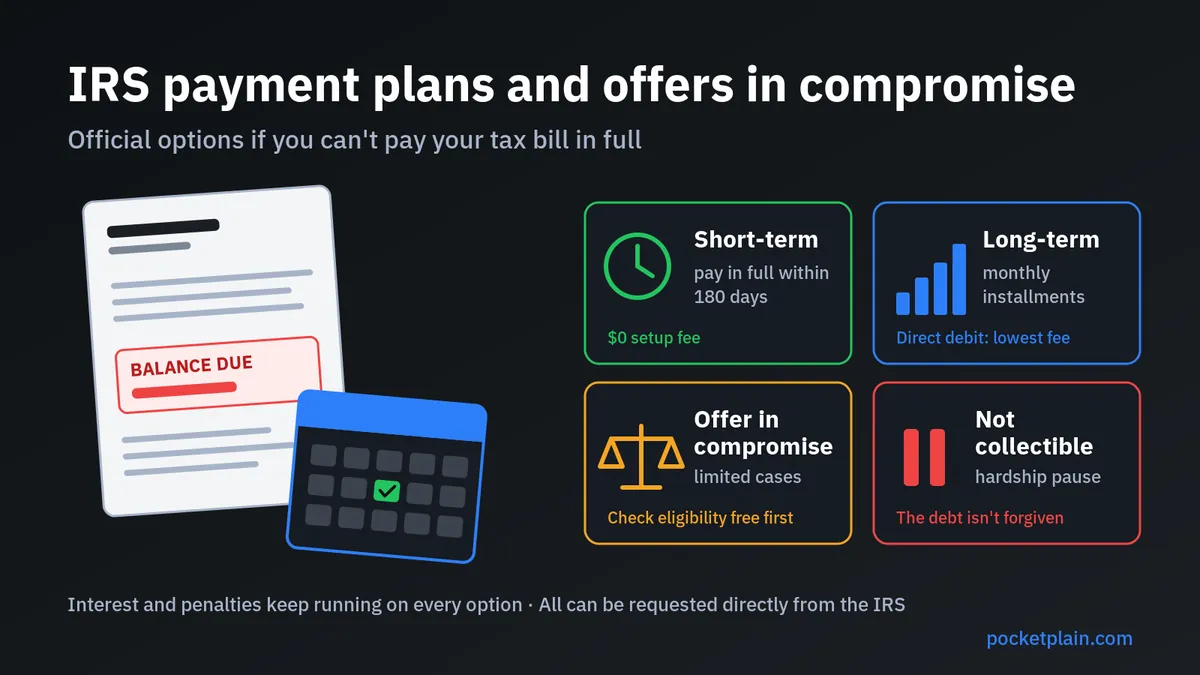
If you owe the IRS more than you can pay right now, you have several official options: a short-term plan of up to 180 days, a monthly installment agreement, an offer in compromise that settles the debt for less in limited cases, or a temporary hardship status called Currently Not Collectible. All of them can be requested directly from the IRS, and none of them stops interest from growing. This guide explains how each one works, what the IRS charges to set it up, and where to find free help, using IRS and Taxpayer Advocate Service guidance checked on October 17, 2026.
Talk to a tax resolution firm: see Community Tax's services
First steps if you owe more than you can pay
File on time anyway. The IRS says a balance you can't pay by the original due date is subject to interest and a monthly late payment penalty, and that there's also a penalty for failing to file, so you should file on time even if you can't pay in full. IRS: Payment plans The penalties differ in size: in the IRS's own example, a month with both penalties would mean 4.5% for failure to file and 0.5% for failure to pay. IRS: Failure to pay penalty
Pay what you can now. Paying part of the balance reduces the interest and penalties that build on it. IRS: Topic no. 202
Check the exact balance. Individuals can see what they owe and their payment history in their IRS Online Account. Several of those account features are now also in the official IRS app; see what changed when the IRS app replaced IRS2Go.
Compare borrowing honestly. The IRS itself says you may want to consider paying in full with a loan or a credit card, because the bank's interest rate and fees may be lower than the IRS's combined interest and penalties. That depends entirely on the rate you're offered. A card balance you carry accrues interest at the card's APR, which our guide to how credit card APR works explains, and it doesn't come with the protections of an IRS plan described below.
Short-term payment plan: up to 180 days
If you can pay the full balance within 180 days, the IRS offers a short-term payment plan with no setup fee, whether you apply online, by phone, by mail, or in person. Interest and any applicable penalties keep accruing until the balance is paid in full.
Individuals can apply online if they owe less than $100,000 in combined tax, penalties, and interest. Only individual taxpayers can request a short-term plan online; businesses must call.
Long-term payment plans and setup fees
A long-term payment plan, also called an installment agreement, lets you pay in monthly installments. Most individuals qualify for what the IRS calls a Simple Payment Plan, generally available if you owe $50,000 or less in assessed tax, penalties, and interest; the payments must pay off the balance by the Collection Statute Expiration Date, which is generally 10 years from when the tax was assessed. The IRS says Simple Payment Plans don't require a collection information statement or a lien determination, that more than 90% of individual taxpayers qualify, and that the longer the term you choose, the more interest and penalties you'll owe. IRS: Simple payment plans
Applying online. The IRS's Online Payment Agreement tool, reached through your IRS Online Account, is open to individuals who owe $50,000 or less for a long-term plan and have filed all required returns. You need a photo ID to create the account, and you get an immediate answer on whether your plan is approved. The tool is available daily from 5 a.m. to midnight Eastern time. Businesses can't apply online. IRS: Online payment agreement application If you don't qualify online, individuals can still apply with Form 9465 or by phone; the IRS typically responds to a mailed Form 9465 within 30 days, but it can take longer during filing season.
Direct debit or not. A Direct Debit Installment Agreement takes automatic monthly payments from your checking account. It has the lower user fee, and the IRS notes that automatic payments reduce the chance of default. Here are the setup fees the IRS lists:
| Plan | Apply online | Apply by phone, mail, or in person | Low-income taxpayers |
|---|---|---|---|
| Short-term (180 days or less) | $0 | $0 | $0 |
| Long-term, direct debit | $29 | $107 | Fee waived |
| Long-term, other payment methods | $69 | $178 | $43, which may be reimbursed if certain conditions are met |
| Revise an existing plan | $6 | $89 | $6 online or $43 otherwise, which may be reimbursed |
Source: IRS: Payment plans. Changes to an existing direct debit agreement have no fee, and paying by debit or credit card adds a processor's fee.
The low-income fee rules apply to individuals whose adjusted gross income is at or below 250% of the federal poverty level. If you think you qualify but the IRS didn't identify you, you can send Form 13844 within 30 days of the date on your agreement's acceptance letter.
Other plan types. Individuals who owe $10,000 or less in tax (not counting interest and penalties) can get a Guaranteed Installment Agreement if, among other conditions, they've filed and paid on time and haven't had an installment agreement for income tax in the past 5 years, and they agree to pay in full within 3 years. If your payments can't clear the balance before the collection deadline, a Partial Payment Installment Agreement may be possible; it requires a collection information statement and financial documents, and it's reviewed every two years. Balances above the Simple Payment Plan limit may still qualify for a plan, but the IRS may require a collection information statement and decide whether to file a Notice of Federal Tax Lien.
Keeping the plan. The IRS will apply future refunds to your debt until it's paid, expects you to file and pay future taxes on time, and may charge a reinstatement fee if the plan defaults. It generally won't take enforced collection action while a plan request is being considered, while a plan is in effect, for 30 days after a request is rejected or a plan is terminated, or while an appeal of either is under review.
Interest and penalties keep running
A payment plan spreads the bill out; it doesn't freeze it. Two charges continue:
- Interest. The IRS sets the underpayment rate each quarter at the federal short-term rate plus 3 percentage points. For October through December 2026, the underpayment rate is 7%, and interest compounds daily. IRS: Quarterly interest rates Under an installment agreement, interest keeps accruing daily on any unpaid amount, including penalties and earlier interest. The IRS doesn't remove interest for reasonable cause; it reduces interest only when the related tax or penalty is reduced, or in cases of unreasonable IRS error or delay. IRS: Interest
- Failure-to-pay penalty. The penalty is 0.5% of the unpaid tax for each month or part of a month, up to 25% of the unpaid tax. If you're an individual who filed on time and you have an approved payment plan, it drops to 0.25% a month while the plan is in place. It rises to 1% a month if you don't pay within 10 days of an IRS notice of intent to levy.
You may be able to have some penalties removed if you acted in good faith and can show reasonable cause. While you pay down a tax plan, keeping other debts under control matters too; if you're juggling several, see debt snowball vs. avalanche.
Offer in compromise: who qualifies and what it costs
An offer in compromise (OIC) is an agreement that settles a tax debt for less than the full amount owed. The IRS looks at your income, expenses, and asset equity, and it generally won't accept an offer if you could pay in full through a payment plan, equity in your assets, or both. IRS: Offer in compromise Submitting an application doesn't mean the IRS will accept it. IRS: Form 656-B
Check eligibility first. The IRS's free Offer in Compromise Pre-Qualifier asks about your finances and calculates a preliminary offer amount; the IRS says it should be used only as a guide, makes its final decision after investigating your full application, and notes that using the tool doesn't guarantee acceptance. Before an offer can be considered, you must have filed all required returns, received a bill for at least one tax debt in the offer, made the current year's required estimated tax payments, and, if you're an employer, made the required federal tax deposits for the current and two previous quarters. You can't apply while in an open bankruptcy.
How to apply. Individuals can submit an offer through their IRS Online Account. Otherwise, the Form 656-B booklet has the forms and instructions: Form 656 and a collection information statement, Form 433-A (OIC) for individuals.
What it costs to apply. Each offer requires a $205 application fee and a first payment, unless you meet the low-income qualifications described below. You choose between two payment options:
- Lump sum: pay 20% of the offer amount with the application, and if it's accepted, pay the rest in 5 or fewer payments within 5 or fewer months.
- Periodic payment: make the first payment with the application and keep paying monthly while the IRS reviews it; the remaining balance is paid in monthly payments within 6 to 24 months, under the terms you propose. Missing a payment before the final decision can lead the IRS to return the offer.
Low-income certification. Individuals who meet the low-income guidelines don't pay the application fee or any offer payments while the offer is reviewed. The Form 656-B booklet bases this on adjusted gross income, or household gross monthly income times 12, and family size; for a one-person household in the 48 contiguous states, D.C., and U.S. territories, the limit is $39,900, with higher amounts for larger families and for Alaska and Hawaii.
While the IRS reviews it. Most collection activity is suspended, the time the IRS has to collect is extended, and the IRS may file a notice of federal tax lien. If the IRS doesn't accept or reject an offer within two years of receiving it, not counting time spent in an appeal, it's automatically accepted. Penalties and interest keep accruing during the review, and the IRS may keep a refund for a return assessed before it accepts the offer; that refund doesn't count toward your offer payment.
After a decision. If the offer is accepted, liens aren't released until it's paid in full, and some offer information goes into a public inspection file. You must also stay current on filing and paying through the fifth year after acceptance, or the IRS may default the offer. If it's rejected, the application fee isn't refunded, payments are applied to your balance, and you can appeal to the IRS Independent Office of Appeals.
Currently Not Collectible status
If paying anything would keep you from covering basic living expenses, you can ask the IRS to delay collection. If it agrees, it can place your account in Currently Not Collectible (CNC) status, which temporarily suspends most collection activity. IRS: Temporarily delay the collection process
The IRS is clear about the limits:
- You still owe the full amount. It isn't forgiven or canceled.
- Penalties and interest continue to accrue.
- There's no fixed time limit; the IRS may review your finances and resume collection if your situation improves.
- The IRS may file a Notice of Federal Tax Lien and will apply any federal refund to the debt.
To request it, call 800-829-1040 or the number on your notice. The IRS may ask you to complete Form 433-F, 433-A, or 433-B and to document your income, monthly living expenses, bank accounts, and assets.
Watch out for "OIC mills"
The IRS's 2026 "Dirty Dozen" list of tax scams includes aggressive or misleading offer in compromise marketing, which it calls "OIC mills." It says these operations often overpromise results and charge high fees to taxpayers who don't qualify for an offer, and that you can check eligibility with free IRS tools to avoid high-pressure sales tactics. IRS: Dirty Dozen 2026 IRS: Tax Tip 2026-40
Some practical checks follow from what the IRS publishes. Run the free Pre-Qualifier before you pay anyone. Be skeptical of any promise of a specific settlement amount: the IRS expects an offer based on what it considers your ability to pay, and it makes the final decision after its own investigation. And if a call, text, or email about your tax debt arrives unexpectedly, confirm it through a trusted channel before sharing information or paying; our summary of the IRS's tax data security reminder covers the warning signs.
Free help and paid help
You don't have to hire anyone to use the options above. When you do need help, these are the main routes:
Taxpayer Advocate Service (TAS). TAS is an independent organization within the IRS that helps people who can't resolve a problem with the IRS on their own, including cases of financial hardship or IRS systems that aren't working as they should. TAS: Contact us Its help is always free. TAS also says its service is free. You can call 877-777-4778 or request help with Form 911; TAS warns that high demand means it may take up to two weeks to return a call.
Low Income Taxpayer Clinics (LITCs). LITCs are independent of the IRS and represent eligible taxpayers in audits, appeals, and collection disputes, for free or for a small fee. To qualify, your income generally must be below a set threshold, and the amount in dispute is usually less than $50,000. IRS: Low Income Taxpayer Clinics For 2026, the income ceiling is 250% of the federal poverty guidelines, or $39,900 for a one-person household in the 48 contiguous states and D.C.; each clinic decides whether you qualify. TAS: LITC
A credentialed professional. Enrolled agents, CPAs, and attorneys have unlimited rights to represent clients before the IRS, including on payment and collection issues. IRS: Preparer credentials For help with an offer, the IRS suggests looking for a licensed enrolled agent or a reputable accountant in your area.
Paid tax resolution firms. Some people prefer to pay a company to handle the process for them. Community Tax is one such firm; you can read about Community Tax's tax resolution services (affiliate link). Pocket Plain hasn't reviewed its services. Before you sign with any firm, ask for the total fee in writing, who will handle your case and whether that person is an enrolled agent, CPA, or attorney, and what the firm will do that you couldn't do yourself with the IRS tools in this guide. No firm can promise that the IRS will accept an offer or reduce what you owe.
Read about Community Tax's tax resolution services
Once the tax bill is under control, an emergency fund can make the next unexpected bill less likely to turn into debt.
Sources and how this guide was made
- IRS payments pages: Payment plans installment agreements, Online payment agreement application, Simple payment plans, Topic no. 202, Failure to pay penalty, Quarterly interest rates, and Interest.
- IRS offer in compromise materials: Offer in compromise, the Form 656-B booklet (Rev. 4-2026), the Pre-Qualifier, and Tax Tip 2026-40.
- IRS collection and scams: Temporarily delay the collection process and the 2026 Dirty Dozen (IR-2026-30).
- Help: Taxpayer Advocate Service, Low Income Taxpayer Clinics and the TAS LITC page, and the IRS page on preparer credentials.
All sources were checked on Oct. 17, 2026. Fees, limits, and the quarterly interest rate can change, so confirm them on IRS.gov before you apply. This guide covers federal tax debt for individuals; state tax agencies have their own rules. The Community Tax link is an affiliate link; it does not change what this guide says.
This content is for general education and is not tax, legal, or financial advice. Your options depend on your balance, income, assets, and filing history; check them with the IRS or a qualified tax professional.